
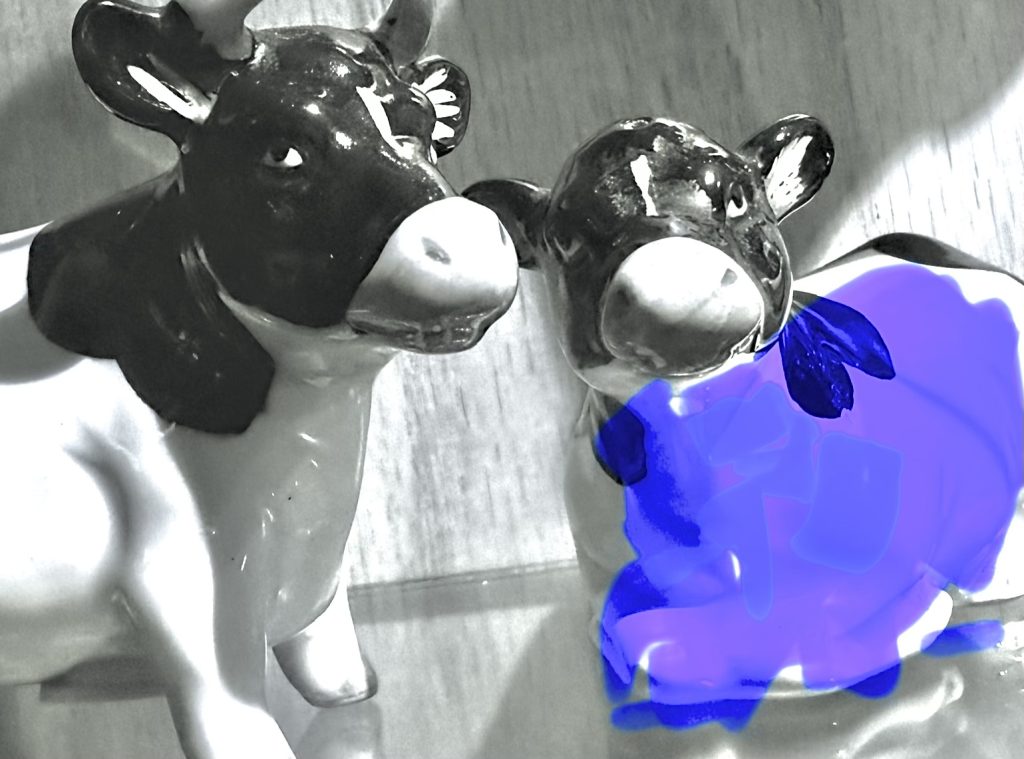
Seeming simple while actually being anything but
Ten years ago last week, an article appeared in a nationally known business magazine that spent most of its 700 or so words finding the flaws in what I have long felt to be one of my favorite marketing-focused books of all time: Seth Godin’s Purple Cow: Transform Your Business by Being Remarkable. The article, of course, isn’t new, but I stumbled on it again the other day. While there’s almost always, I know, some merit to any criticism, my frustration level rose a little with each critical line I read. Not, per se, because Seth is a friend—he hardly needs me to defend him. Rather, my focus is just on the practical contrast between criticism coming from afar, after the fact, and creation emerging from within as a means to making something special happen in the world.
The former, alas, is far too common. Criticism costs nothing, but all too often gives the critic an excess of short-term attention. That attention, though, nearly inevitably fades into nothingness in no time flat. I learned long ago that critiquing takes very little work; creation, on the other hand, is far more difficult, requiring the willingness to be vulnerable and authentic, and to put one’s heart and soul out there in the world.
To that point, although the critical article on Purple Cow is still up online, it has long since been forgotten. The book, meanwhile, continues to push forward. It remains a classic and, over the years, has become one of the all-time bestsellers in the field of forward-thinking business leadership. And as Seth himself says about criticism in the pages of Purple Cow,
If you’re remarkable, it’s likely that some people won’t like you. That’s part of the definition of remarkable. Nobody gets unanimous praise—ever. The best the timid can hope for is to be unnoticed. Criticism comes to those who stand out.
Of course, the odds are quite high that if you’re reading this essay, you’ve also already read Purple Cow. It’s also really likely that it resonated with you. The point of Purple Cow is to encourage all of us to push past criticism and create, in spite of social pressure to stay within the “norms” of the mainstream.
In historian Timothy Snyder’s remarkable book about resisting autocracy, On Tyranny: Twenty Lessons from the Twentieth Century, number one on the list is strong and direct: “Don’t obey in advance.” Purple Cow is, in essence, a kind of business-design corollary to this. As Seth says,
Companies that are built around mass marketing develop their products accordingly. … These companies make spicy food less spicy, and they make insanely great service a little less great (and a little cheaper).
In the spirit of the anarchist belief that the means we use to accomplish something must be aligned with the outcomes we’re working to achieve, Purple Cow is itself a Purple Cow. (Read this to be reminded of Seth’s superb word-of-mouth marketing for the book’s rollout back in the day, which was ingeniously both “in the box” and out of the box at the same time.) All these years later, Purple Cow continues to stand out in a crowded field. It was something special when it came out, and it remains so still today—an enormous help to anyone looking for creative business insight.
Purple Cow was originally released in mid-May 2003, just as we were working on the run-up to formally opening the Roadhouse early that coming autumn. Just like the book, the restaurant is still, I’m happy to say, going strong, having also celebrated its 23rd anniversary this year. A second edition of Purple Cow came out 17 years ago this week, in November 2009, and the book has sold over 1,000,000 copies over the course of its two-plus decades. By my rough math, the Roadhouse is right about at the same spot—between carryout, bar, and dining room guests, we’ve probably served something like 1,000,000 folks as well.
The Roadhouse, of course, does not have “purple cow” on the menu, but really, reflecting back, I’d say that the restaurant actually is one. In line with what Seth says so well in the book, the Roadhouse was initially—and, even now, still is—about doing what few others at the time were up to: offering exceptionally flavorful traditional American dishes—a wide range of regional flavors from across the continent. Everything from well-known classics like fried chicken (made with free-running chicken from Amish farmers in Indiana) and macaroni and cheese (made with maccheroni from the only farmstead pasta maker in Italy, the Mancini family in the Marche) to Lake Superior whitefish; New Mexico fire-roasted, hand-peeled green chiles; and hand-squeezed limeade that has an Ann Arbor history dating back to Drake’s Sandwich Shop on North University in the 1920s.
To be clear, I’m using the Roadhouse example here only because the restaurant opened the same year that Purple Cow came out. You could say the same things about Miss Kim, the Candy Manufactory, the Bakehouse, et cetera.
In part, Seth has shared, Purple Cow was written as an homage to the memory of his friend Lionel Poilâne, the great Parisian baker, who was tragically killed in a helicopter crash in 2002. I loved Poilâne’s bread the first time I had it in Paris nearly 40 years ago now, and both the man and the bakery were inspirations to Frank Carollo and Amy Emberling (Bakehouse managing partners back in the day), and to me as well. Baking old-school pain au levain in big, dark-crusted, three-kilo loaves stood out in a field that was moving more and more into industrial breads that “looked fine” but had increasingly less flavor. As Seth says, “The key to success is to find a way to stand out, to be the purple cow in a field of monochrome Holsteins.” There is no question in my mind that both the book and the bread successfully made that happen.
Now, a decade after the critical article I mentioned above came out, Seth carries on apace. As he writes in Purple Cow, “You do not equal the project. Criticism of the project is not criticism of you.” My point here, I’ll emphasize, is not to critique the criticism—it’s actually the inverse. It’s all about advocating for the uncommon, and reminding myself and anyone else who’s interested that, while there may well be more short-term money to be made by staying well inside the lines of the socially sanctioned mainstream, the far more rewarding path forward is to skip past the routine offerings and do something unique and meaningful. Yes, of course, if you’re a Purple Cow, it’s pretty much inevitable that a couple of the other cows will criticize your look. “C’est la vie,” Seth might say if he were speaking French, in which case his book would be called La vache pourpre.
The point of Purple Cow is not to figure out how to sell your stuff to everyone on the planet. It’s about doing something different from what everyone else is doing. Not different just for the sake of being different—different in the sort of way that will engage the specific sorts of folks (the “minimum viable audience” is probably what Seth would say) to whom you want to sell.
The book also encourages anyone who’s considering doing something bold to free their inner anarchist (my term, not Seth’s) and initiate the work they’ve been dreaming about. As James Clear, now one of the biggest-selling business authors anywhere, says about his own early efforts,
For over a year, I didn’t have the courage to share my work. I wrote in a private document. I played it safe and tried to shield my words from criticism and judgment. Eventually, I decided that it was more important to contribute something to the world than it was to protect myself from criticism.
Three years ago this winter, on March 15, 2024, we celebrated our 42nd anniversary at Zingerman’s. Unbeknownst to me—and, most likely, nearly everyone else around Ann Arbor at the time—3,800 miles to the east, in Lisbon, the then 25-year-old Portuguese musician Ana Lua Caiano released her third album on the same day. It’s entitled Vou Ficar Neste Quadrado, which, in English, translates to “I shall stay in this square.”
Caiano and her music are both the exact opposite of the album’s title—her records are magical, marvelous, remarkable, and unlike anything else I’ve ever heard. I mean, seriously, she’s so far outside the square, she probably can’t even see it. Her work—and mine, and, for that matter, this entire essay—is about inverting what she’s put in the record’s title and getting out of the square. Or steering clear of the square altogether. Or maybe it’s about starting to work in circles while most of the world is stuck inside squares they don’t love but nevertheless opt not to leave.
“Safety first” is a perfectly fine slogan when it comes to handling chemicals, cars, knives, and the like, but it may well prove to be the creative undoing of a whole lot of people out in the wider world. The title of Caiano’s album is a critical reference to the many folks in the social mainstream who are seemingly quite comfortable spending their lives stuck in the safety of a socially imposed “square.” Or, as Caiano sings in “Uma Vida a Menos,” the terrific 12th cut on her latest album, Devagar Que a Vida É Curta—released at the end of last week—“There are more men buried in work than in graves.”
Caiano’s tunes are not just musically engaging. She has a point of view and, in good Purple Cow fashion, she’s very willing to share it. Her lyrics touch on Portugal’s housing crisis and refer to any number of significant contributors to the history and culture of the country, especially the Portuguese Revolution of 1974. Of the latter, she shares,
There are a lot of amazing songs from that time that were very important for the revolution that happened in 1974. But if I had to name a song that I like the most, I would name “Os Vampiros” by Zeca Afonso. This song talks about the vampires—the vampires in this case were the members of the dictatorship. Of course, during this time there was censorship, so the lyrics had to be very well written, and the meaning had to be disguised so that the song wouldn’t be censored.
What impresses me the most in this song is the ability to talk about the biggest atrocities committed by the [Portuguese] dictatorship without being too obvious or too direct. Zeca’s songs were very important for the revolution. In fact, one of his songs, “Grândola, Vila Morena,” was used to announce the revolution on the radio! So music and revolution in Portugal are intrinsically connected.
(Zeca Afonso—whose full name was José Manuel Cerqueira Afonso dos Santos—was, indeed, an amazing folk singer. Called by some the Bob Dylan of Portugal—or now, by me, the Willie Dunn of Europe’s left coast—Afonso was one of the few revolution-focused musicians whose revolution actually came to fruition, with the “Carnation Revolution” of 1974.)
Caiano’s interest is clearly not just in critiquing what once was. She’s committed to creating and, in the process, contributing to a positive future. As she explains, “My belief is that music can be a way of repairing, thinking, and criticizing some of the colonial repercussions that still exist today.”
In a sense, Caiano’s musical story is summed up in some of her videos, where you can see her singing while working away at a synthesizer with one hand and traditional drums with the other. Watch even the first few minutes of this video of her performing in the famous wine town of Porto in 2024, and you’ll pick up on her passion, her engaging energy, and the complexity—or, I suppose we can say, Purple Cow-ness—of her music, even without understanding a word of Portuguese. As she says,
I have the desire to break and distort the norms. On each record, I play more with the musical elements and song structures. … When I talk about traditional Portuguese music, I’m not talking about fado, I’m talking about a type of sonority sung in the countryside using canons, harmonies, and chorus. It was mostly transmitted orally.
Caiano, as you can tell, is bringing these traditions alive again here at the start of the second quarter of the 21st century.
Speaking of cows and remarkable art … Caiano’s video for “Uma Vida a Menos” was named “Music Video of the Week” by the Berlin Music Video Awards in August. As the group writes, “Some music videos require a little more logistics than others. For this project, the production brought together 36 cast and crew members, three tons of soil, a live pony, and, eventually, a whole herd of cows.” No purple ones, but when’s the last time you saw three dozen cows loose and nuzzling up to the vocalist in a music video?
Ana Lua Caiano is, to my eye, proof positive that anything is possible. She is, we might say, a musical Purple Cow (or, in Portuguese, a vaca roxa). Seth Godin says, “In a crowded marketplace, fitting in is failing. In a busy marketplace, not standing out is the same as being invisible.” Caiano absolutely stands out. Even if you don’t love her music the way I do, it’s immediately apparent that what she’s doing is most definitely not like the work of anyone else around, bringing together great traditions from the past with 21st-century techniques.
In Episode #55 of his thought-provoking podcast, Living Myth, philosopher Michael Meade “focuses upon the idea that a genuine tension of opposites can produce something imaginative, vital, and unifying.” And that is, indeed, what Ana Lua Caiano embodies with her music. In a January 2024 article for OFFKEY, Liv Toerkell writes,
The Portuguese artist Ana Lua Caiano describes her music as “a mixture between traditional Portuguese music and electronic music.” Her songs weave unique textures with traditional Portuguese harmonies and raw electronics. “I want to join the ‘old’ with the ‘new’ in my music,” Ana says. The complex rhythms and multilayered vocals connect her to a lineage of orally preserved music that continues to be practiced in the countryside across Portugal. The singer also cites political artists from the Portuguese revolution of 1974 like Zeca Afonso, Fausto Bordalo, and Sérgio Godinho as inspiration for her sound, alongside contemporary electronic influences like Portishead, Björk, and Laurie Anderson.
Of Caiano’s second album, Se Dançar É Só Depois (“Dance Will Be For Later”), Toerkell writes,
We hear electronic elements combined with the use of traditional fado instruments and Portuguese choral harmonies and canons. The synthesizer interruptions come as a surprise and yet embed themselves perfectly within the folk tunes.
This approach of taking seemingly antithetical opposites and blending them into something unique, special, and compelling—or, as Seth Godin would write, “remarkable”—is what this essay is all about. It’s about having the confidence to create our own niche, a space that’s true to us but also truly appealing to enough potential customers that we can make a living.
Last week, the Austin-based author Cecilio Blanco Ledesma published the latest in a series of essays he calls “Letters to My Son.” The pieces are, as the title implies, letters to his young son, but they are also, he adds, a way to create conversations he never had with his own father. The essays have also now been published in a book entitled Letters to My Son: 22 Letters on Love, Legacy, and What Traveling the World Taught Me About Being Human. In the piece published last week, Blanco advises his son to “Be Impossible to Explain.”
The essay is, in the best possible way, Ledesma’s parental version of encouraging his kid to become a Purple Cow. Needless to say, I loved it. He writes,
Son, do not become easy to explain.
This is, I would say, wise advice—to not get stuck in one of the “squares” that Ana Lua Caiano has been singing about on the other side of the Atlantic. Ledesma’s piece is essentially an invitation—nay, an active and outright encouragement—for his son to create a life that would be his own personal, eminently human version of a Purple Cow:
My dear son,
You are handed a script before you even know who you are.
It starts early. Sit still. Be realistic. Pick something sensible. Don’t fail publicly. Don’t speak too loudly. Don’t dream too dangerously. Wear what everyone else wears. Want what everyone else wants. Stay close to the middle where nobody criticizes you and nobody remembers you either.
People spend their entire lives negotiating with that fear.
And then they wake up one morning in a quiet kitchen with gray in their hair and realize they became understandable to everyone except themselves.
Ledesma is certainly not the first person to make that observation. Much of what drew me to studying so many anarchists was their adamant admonition to people to own their lives and live in ways true to their own spirit. Getting stuck inside socially accepted norms is all too common. It happens to individuals, and it happens to businesses, too. Sticking to the middle of the road isn’t necessarily evil. Most businesses, in fact, fit that mold: they might be doing fine, but they’re stuck in the box. This is not, as you know, a way that I would ever want to go—it’s just not interesting. And it’s certainly not a path to greatness.
Ledesma continues,
There is a kind of tragedy in living a life so predictable that nobody is ever surprised by your courage. There is a sadness in becoming a man who slowly edits himself down into something acceptable.
People have done it for years. Good men. Intelligent men. Men who once carried wildness in their chest. They traded it away piece by piece for approval, comfort, routine, and safety.
At first, it feels harmless.
You stop saying what you really think. Stop chasing the thing you really love. Stop risking embarrassment. Quit risking rejection. Stop risking failure.
And slowly, without noticing, you stop risking life itself.
The situation Ledesma describes here is what both Seth Godin and Ana Lua Caiano are also appealing to us to steer clear of. I love his way of expressing it. In closing, he repeats his main message:
Son, do not become easy to explain.
Live in a way that confuses people who have mistaken comfort for wisdom.
Ledesma’s advice seems sound, I’ve started to realize, for businesses, too. Not that it’s “bad” to have a business that’s easy to explain; there’s certainly some merit to it. It’s just that a lot of the greats—in business, in music, in art, in life—are the people who do something in ways that no one else is doing it. Believe me, they make it work, but they put the pieces together in ways that nobody has ever seen—ways that are neither easy to replicate nor, per Ledesma’s wise words, “easy to explain.”
A couple of examples that come quickly to mind? There’s no Purple Cow College to offer certification, but how about Alabama Chanin and its umbrella organization, Project Threadways—a nonprofit in a small town in North Alabama making high-end, handsewn garments and other good things with only American cotton? Not to mention that they have a School of Making, where they teach old-school sewing techniques, and a superb symposium (where I will be next April) every spring. Or Zak the Baker, where I just did a great book event in Miami last week—an artisan bakery run by a nonreligious Jewish baker that’s strictly kosher and that has established itself as a bastion of good eating in a city loaded with national franchises. I’m sure you have other examples in your own communities as well, and that many of you reading this run such organizations yourselves!
It certainly happens in the arts, too. Asked in an interview, “Can you describe your music?”, Ana Lua Caiano says, “So it’s a little bit of a mixture between traditional Portuguese music and electronic elements. And also, these elements from our daily life. For example, fridges, cars, cups.” She also, I know, plays piano, organ, bagpipes, and—yes, you’re reading this right—lemons! There’s also an array of ancient Portuguese drums in her music: the pandeiro, which is a sort of hand-framed drum; bombos, or large bass drums; and the adufe, which is a square, double-skinned-frame drum that dates back to the arrival of Arab peoples on the Iberian Peninsula in the eighth century.
Now, granted, I realize that having a business one can’t explain to customers isn’t ideal. People need to know what you’re making/selling/serving if they’re going to decide to buy it (or donate to it if it’s a nonprofit). I like what master marketer Donald Miller emphasizes about the import of what he calls “the one-liner.” We need to be able to share—quickly, effectively, and compellingly—what we’re up to in order to get our customers to come in.
But, that said, I’ve begun to hold the tension of opposites that Michael Meade references above so poetically—and I’ve come to believe that, as he says, we can do both: we might, at the same time, be hard to explain and also be able to communicate something meaningful about our products and/or services in, at most, a couple of sentences. The two seem at odds, I know, but they actually create something beyond what others have ever imagined. As the innovative systems thinker Donella Meadows says, “You think because you understand ‘one’ that you must therefore understand ‘two,’ because one and one make two. But you forget that you must also understand ‘and.’”
We can, with creative effort and a commitment to connecting things that have otherwise been unconnected, develop Purple Cow–like projects that we’re able to sell concisely, even as they remain exceedingly difficult to explain. In an essay entitled “Holding the Tension of Opposites,” British family systems practitioner Gavin Conochie writes about Michael Meade and his philosophical framing:
When we genuinely suffer the tension of the opposites, something unexpected will occur. Something as yet unconscious or unknown will become conscious to us, and with that awakening there will also come a renewal of vitality and basic life energy. Without visions that transcend the tension of the opposites, we cannot find ways to truly change or genuinely heal that which divides us and turns us against one another.
What we often fail to appreciate is that the tension we encounter in this kind of decision-making is, in essence, a creative force—one that has the potential to bring renewal into our lives. More than that, this tension of the opposites, as Jung called it, can in fact be a necessary precondition for real transformation to occur—it’s how we grow. If we are able to hold the tension, rather than rushing to choose one option over the other, there is the potential for something new to emerge. This third possibility could be an idea, an image, a feeling, a fresh way of understanding our situation, or a new way of inhabiting it. Its arrival on the scene resolves our dilemma in a way that transcends the need to choose one side over another.
Seth Godin himself is much the same. I often write that he’s a “marketing guru,” but the truth is, if I were to really detail all the amazing things he does, it would become a book as massive as his 800-page 2012 missive, This Might Work. In that sense, Seth is a good role model for Cecilio Blanco Ledesma’s son to see what is possible when you design and live a life that’s hard to explain in the best of ways.
At the same time, I have long lived with the reality that describing Zingerman’s is also anything but easy. When I get interviewed (which happens a lot), folks often frame their first question as something like, “Can you give our listeners a 60-second synopsis of what Zingerman’s is?” My answer, which I’ve given a million and a half times over the years, is some version of, “Well … not really. It’s not that simple.” The bottom line, of course, is that, nearly 45 years down that hard-to-explain road, the Zingerman’s Community of Businesses (ZCoB) now does over $80,000,000 in sales per year and employs over 700 people. (We’re hiring a few hundred more right now for the holidays to work at Mail Order—check it out …) So, yes, we’re very hard to explain (in a very good way), and yes, our organization seems to be doing just fine anyway.
When I think back, this concept of bringing together opposites to create something new and special is at the essence of the entire Zingerman’s story. In March of 1982, 42 years before Ana Lua Caiano released her debut album, we opened what many simply called “a Jewish deli.” That was the easy part. In practice, though, what we had begun to create was (and still is today) all about the pairing up of seemingly incompatible, paradoxical opposites: We were a Jewish deli, but we sold plenty of pork products. We sold both sandwiches and retail items in the same space (unheard of at the time). We had tables tucked in under retail shelves. We were (and still are) making everyday food that people were well accustomed to, but making it with world-class ingredients of a quality one would never expect to find at a corner deli in a small Midwestern town. We gave the same great service to 16-year-olds coming over from Community High School and spending 60 cents as we did to world-famous football players who’d flown in from New York on private planes.
All these years later, we’ve created an organization with lots of processes, systems, recipes, and frameworks, weaving them all together with one of the founder’s advocacy for anarchist beliefs. Which is why, when people ask me “What is Zingerman’s, anyways?”, I have continued to respond with some version of, “Wow! It’s not that easy to explain.”
Coming back to where we started, why does all this stuff about Purple Cows and cutting-edge Portuguese folk music actually matter?
My strongly held belief—backed up by decades of both practice and study—is that people who are doing special things of this sort are almost always much more engaged and energized. They’re contributing back to their communities. They’re learning. They’re having more fun. And, like Cecilio Blanco Ledesma’s son when he grows up, they’re more likely to live positive, meaningful lives.
On the 1st of January, 2003, four months before Seth Godin published Purple Cow and eight before we opened the Roadhouse, Bo Burlingham wrote an article about us in Inc. He didn’t call us a Purple Cow, but the headline, “The Coolest Small Company in America,” pretty much said the same thing. Building on that article, four years later, Bo published Small Giants: Companies That Choose to Be Great Instead of Big, of which we and our out-of-the-mainstream way of working were a big part. In Small Giants, Bo says what I believe applies to anyone who does something special—something about which they’re passionate, and about which customers come to care deeply:
If there’s one thing that every founder and leader in this book has in common with the others, it is a passion for what their companies do. They love it, and they have a burning desire to share it with other people. They thrive on the joy of contributing something great and unique to the world.
Forty-five years ago this week, I gave two months’ notice at my job. I’d been running kitchens for a local restaurant group. The work was fine, the people were fine, the pay was fine, but I did not have the kind of passion for that company that Bo would later go on to describe. It was all perfectly “okay,” but it was not the type of work that Seth Godin writes about, the kind of art that Ana Lua Caiano is currently creating, or the sort of life that I forecast Cecilio Blanco Ledesma’s son is going to lead when he gets older.
Back then, I didn’t have the language that I have now. I’d not yet heard of Seth Godin, and the only cows I knew about were the black-and-white kind I’d seen on school trips to the countryside when I was a kid in Chicago. In hindsight, however, I see I was stuck in one of those squares Ana Lua Caiano sings about. Like her, I had “the desire to break and distort the norms,” and it sure wasn’t gonna happen in my then very mainstream, perfectly fine, well-paying job. I decided it was time to move on because—even though I couldn’t really explain it to anyone else—the job just didn’t feel like it was going to help create the life I wanted to live.
Seth Godin says, “When something matters to you, you talk about it, care about it, research it, tweak it.” When it starts to matter a lot less, if you want to hold onto your soul and stay true to yourself, you leave. And that’s what I did.
Totally unsure of what would come next, I gave my sixty days’ notice. Two days later, Paul Saginaw—not even knowing I had given notice—called to tell me we should go look at this little building near Monahan’s Seafood Market, which he’d opened a few years earlier with Mike Monahan. The following year, that building would become Zingerman’s Delicatessen. The rest is a whole lot of wonderfully hard-to-explain history.
There is far more at stake in doing the kind of powerful, impassioned work I’ve explored in this essay—and that we practice every day at Zingerman’s—than any business school curriculum would be likely to convey. What we can’t know for sure in our heads, we often already know, intuitively, in our hearts. And when we follow that intuition, we tap into what the 20th-century revolutionary Portuguese poet Sophia de Mello Breyner Andresen describes as “the entireness of my being, a consciousness running deeper than intellect.”
The Portuguese revolution of 1974 that still inspires Ana Lua Caiano’s amazing music today, half a century later, peacefully changed the course of the entire country. On a smaller but no less important scale, people like us—those who do the kind of creative, cutting-edge, beauty-bringing, out-of-the-box work that Seth Godin, Ana Lua Caiano, Cecilio Blanco Ledesma, and we at Zingerman’s do—benefit others, bring joy and good learning to folks, and contribute meaningfully to the ecosystems of which we are a part. Purple Cows, it’s clear to me all these years later, have the potential to create positive communities that can and will make a meaningful difference for a long time to come.
As Seth Godin writes in his recent book This Is Strategy,
The seeds you plant today won’t grow for weeks or months. The systems we support, the people we dance with, the ruckus we create—it’s not for today, it’s for tomorrow. We’re here, now, but we live in the future. We are making history.
Other Things on My Mind
Listening
Following up on the lead essay, let me again recommend all the records of the Portuguese musician Ana Lua Caiano.
Studying her story and her music also turned me on to the Portuguese folk musician José Afonso, who, as I mention in the essay above, came to be known as Zeca. Afonso had a very prominent role in Portuguese history that makes him as important to mid-20th-century protest music around the world as anyone. Born in the summer of 1929, he spent much of his childhood in the then Portuguese colonies of Angola and Mozambique. He began playing folk music in the late ’50s and early ’60s, right around the time Bob Dylan was doing the same in New York City. The song “Os Vampiros” that Ana Lua Caiano mentions is magical, as is “Canta Camarada,” the song of the comrades. Afonso’s song “Grândola, Vila Morena” became a signal used on the radio by the resistance forces in the peaceful 1974 Carnation Revolution. His last album, Galinhas do Mato, was his 16th. It came out in 1985, when Afonso was already too ill to sing all his own songs, so many cuts feature his friends and fellow musicians filling in. He died at the end of February 1987. I’m working my way through his many records. Truly remarkable!
Thinking back to Portugal of that era reminded me of the 1978 record M.P.L.A. by the Jamaican British reggae musician Tapper Zukie. The MPLA was the People’s Movement for the Liberation of Angola, which fought to end Portuguese colonial rule in Angola. The title song is still great—and Zukie was only 21 when it came out!
On a totally non-Portuguese note, I had a great podcast conversation with Joe Salonia (our importer for the exceptional artisan Swiss cheeses of Gourmino) about “Why Democracy Matters” on his show, Cutting the Curd,on Heritage Radio Network.
Loss
John Thorne, one of the great American food writers of all time, passed away at the end of October. John and his newsletter, Simple Cooking, were a huge help and a big influence on me when we were getting going in the ’80s. He was very supportive of us in the ZCoB, and he was a wonderful advocate for the kind of simple, traditional food that is still, to this day, at the core of what we do here. His writing was always accessible, personal, and to the point. Here’s one shorter article about him from eight years ago by Gabriella Gershonson. The New York Times did a great piece about Thorne as well. In hindsight, Thorne successfully made Simple Cooking into the kind of Purple Cow project I write about above. Today, of course, food writing is readily available almost anywhere, but back in the early ’80s, it was anything but common. And doing it in the down-to-earth, totally unpretentious way that Thorne did it made him really one of a special kind.
Reading and Watching
My friend Carne Ross, a former British Foreign Service diplomat turned amazing anarchist author, has been running a great series about “How Power Works” on his Substack. In this video conversation from 2013, Carne talks about his courageous decision to leave the Foreign Service in 2004, during the conflict in Kosovo and the war in Iraq, after struggling to deal with the reality that upper-level British diplomats were lying about the situations in those countries. In the context of the lead essay above, it’s one thing to say we should get out of our socially sanctioned “squares”; it’s another altogether to actually act on it. (You can read more about Carne’s decision here as well.) As Carne says quite openly, “Had I had children, had I been 10 years older, I wouldn’t have done it.” His choice to step forward and speak up seems to have particular relevance in our current American political moment. Carne’s 2017 film, Accidental Anarchist, is a great look into the very anarchist Kurdish revolution in Rojava. I’m about to start reading his new book, There We Are Human Again: A Diplomat’s Journey to Anarchism.