
“How do you know a pamphlet is done?” and other curious questions
Over the years, I’ve noticed a pattern. As I move closer to a perceived “conclusion,” I don’t grow calmer. And unlike many folks I know, I don’t really get excited either. What I do do is wonder.
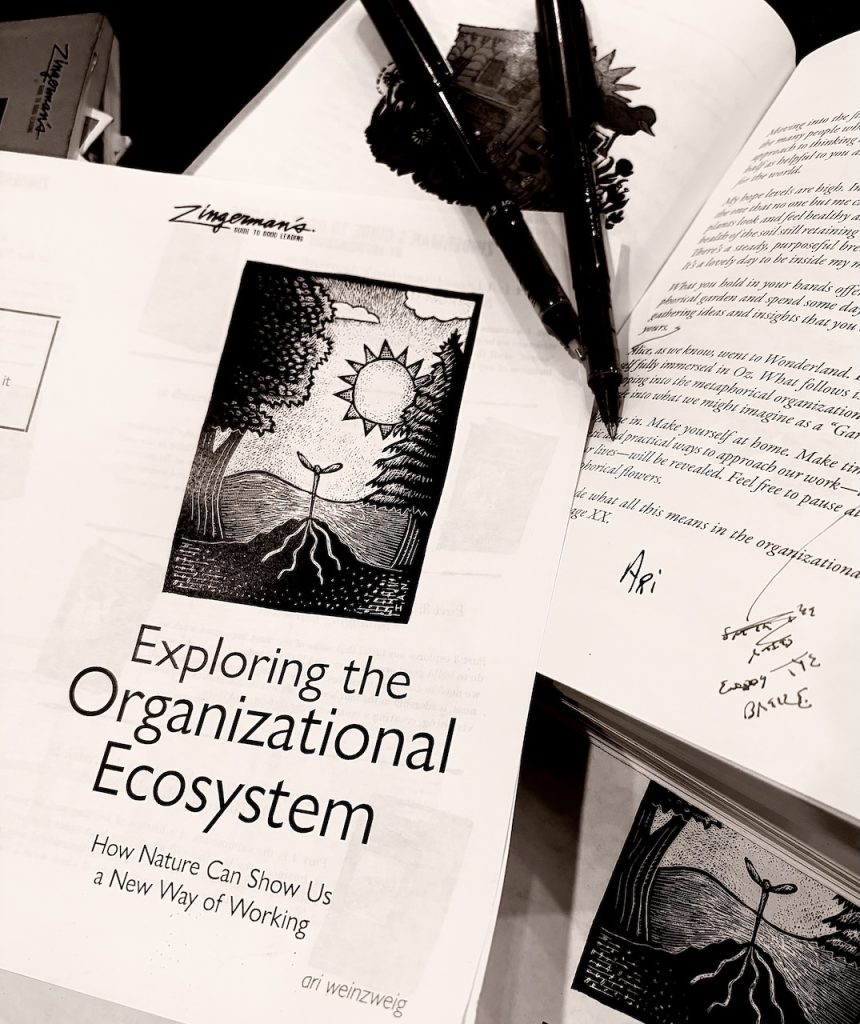
In this case, my curiosity is coming from the impending conclusion of the work to get the next pamphlet to the printer (Dollar Bill Printing, right here in Ann Arbor). It’s tentatively titled “Exploring the Organizational Ecosystem: How Nature Can Show Us a New Way of Working,” and we are now in the final stages of editing, re-editing, line editing, proofing, rearranging pages, sorting through cover designs, and, through it all, moving steadily forward.
The work is going well, but in the back of my mind, the question keeps coming up: how would I really know if the pamphlet is truly, actually ready to go to print? That feeling is summed up, I think, in a poem entitled “A Box With No Sides,” by singer-songwriter Carrie Newcomer:
I have never written a song because
I had an answer.
I write songs because I have questions. …And so, it is still the questions
That keep calling me forward
And encourage me inward
Like a spiral bound notebook
Ever inviting and opening
What follows is about just that kind of question. When Carrie Newcomer has questions, she writes songs. I write essays. As Newcomer notes, “On the edge of so much uncertainty, how important it is to be asking good questions.” And this, to her point, is the query that has been on my mind and close to my heart over the last couple of months: again, I keep wondering, when is a book—or a piece of art, a class design, a film, a work project, a poem—finally finished? And in this case, how do we know it’s okay to send the pamphlet to print when we also know that we could continue working on it for many more weeks—or, for that, matter months and years—improving it a bit more every day?
That hard-to-answer question aside, the practical reality about the new pamphlet is that the plan is to have copies back from the printer and up on websites and ZCoB (Zingerman’s Community of Businesses) counters for sale sometime around Christmas. As the amazing reggae guitarist and songwriter Peter Tosh, one of my favorite musicians ever, said in the song he released a couple of weeks before Christmas 1978, “Soon Come.”
At this stage in the book-production process, most of my friends who write professionally are more than a couple of steps removed from the work, waiting at home for the people at the publishing house to do their last edits, proofreading, and layout, and send back near-final page proofs. While questions certainly come up here and there as the process proceeds along apace, more often than not, by this point, 90 percent of the work is done. And for many authors, the book is out of sight and, in a weird sort of way, out of mind.
Since we long ago decided to publish the books and pamphlets I write independently, well away from the mainstream publishing world, around here it’s a different story. Because we do the entire process in-house, as we take these last steps to get the pamphlet to the printer, I’m fully engaged with Zingerman’s Press’ Jenny Tubbs and ZCoB writer and editor Cary Gitter on the fine-tuning—the tiny tweaks and adjustments that many authors don’t have the opportunity to do.
In a sense, this work is very different from the work of actual writing that it takes to have gotten the book this far in the first place. Some friends I know have, by this juncture, grown understandably tired of the whole process, but, strange soul that I am, I actually enjoy this part enormously. Yes, I definitely love doing the writing—and all the creative exploration, study, and extensive learning that accompanies it. But the truth is that I also love trying to figure out how to turn the writing into something we can effectively and artfully put into print: The polishing. The reading and rereading and re-rereading. The work of looking lovingly at line breaks. Figuring out pieces of the pamphlet that might, despite everyone’s best efforts, still be missing. Finding ways, as we put the layout together, to say the sort of stuff that I somehow never notice until we reach this point in the process. Working on the rhythm by reading aloud in my head over and over again. Accenting the alliteration. Pushing the prose-ish poetry to the fore. Smoothing out any off notes. Listening for the silences that emerge from the spaces between the words. Striving, of course, to reduce repetition, and to keep crafting the sentences for ever-increasing clarity.
At the same time—for me, at least—this stage is also rather anxiety-inducing. Writing on my own is one thing. The energy shifts, though, as knowing that what I’ve worked on mostly in private for years now will soon be in print for everyone to read is, to say the least, emotionally challenging. As I’ve said many times and will surely say many more, I spend much of my life living with varying degrees of fear. In the metaphorical model of the organizational ecosystem, fear correlates with that strange, foreboding way the air shifts when a big storm is about to roll in. That’s where I’m currently at. Over the years, I’ve taught myself to face the fear and to gently but firmly walk forward anyway. Right now is no exception. And, per what I wrote above, that fear is accompanied by curiosity, as, all the while, I continue to wonder: how would I know if this thing is really ready to send to the printer?
Every human has almost certainly experienced something similar in their own sphere and in their own way. For those who write, how do you know when your book is “finished?” When is the poem ready to publish? When is a song ready to be recorded? And when do you decide not to do yet another take before a record is a wrap? When do you know that a painting is ready to post for sale? When is the company’s new product ready to be rolled out? And, if it’s a brand-new business we’re talking about, when are you ready to officially open your doors? The answers are—arguably, at least—almost always really clear in hindsight. But in the moment, when one starts moving toward “going public”—crossing the philosophical finish line, engaging with the ending, letting something you’ve sunk so many private hours into go out into the world for others to experience for themselves—it’s … a lot, with no clear or obvious answer. Or, as Carrie Newcomer puts it, “A question is a box with no sides.”
In a sense, I realize I love restaurant work because there are so many clear boundaries around this sort of thing. The amount of time one can take finishing and fine-tuning work on shift is very tightly bound by time. We can’t sit on your sandwich order for another few days to make sure we’re happy with how it looks. When you order ribs at the Roadhouse, we’re appropriately obligated to get them to the table in 15 or 20 minutes. The crew at Miss Kim can’t wait a couple days to craft the tteokbokki you order for lunch on Tuesday. We can’t decide to push back delivery of a catering order by a week to work out whether we’re okay with it all. Whatever goes down with one order, the reality is that the next one is nearly always only a matter of minutes (or even seconds) behind it. And, of course, no matter how the day went, tomorrow is right around the corner.
Putting out pamphlets like this one, though, is very different from putting out platefuls of food. Whereas the latter emerge from the kitchen in time frames measured in minutes, we’ve usually put a full year’s work into a pamphlet before it’s ready to be published. For bigger books, that time frame might be two, three, or even four years! The end point could be moved … endlessly. What’s another 18 weeks when we’ve already been working on something for six years?
Carrie Newcomer says, “A question is a curious animal, shy and brash and bold and beckoning.” And the question here—once more—is: how the heck would one know that a pamphlet is actually done and primed for the printer?
What follows are five metaphorical frames I’ve come up with in my imperfect effort to figure all this out. The work is complete and ready to share when:
1. You’ve done right for your own level of learning.
One of the best answers I found to this philosophical question came from the poet and musician Linton Kwesi Johnson. To be clear, when Linton Kwesi Johnson (aka LKJ) speaks, I always listen. That was true back in 1978, the year Johnson’s first (awesome) album,Dread Beat an’ Blood, came out—the same year, too, that I started learning to line cook. Johnson, who was born in Jamaica in 1952, moved to England with his parents when he was 11. He was struck by the inherent and shockingly extreme racism—both overt and also not so obvious—that he encountered almost immediately upon arrival in the UK. In the spirit of my chocolate-making friend Shawn Askinosie’s belief that “our vocation is the healing of our childhood wound,” most all of Johnson’s music and poetry build on that experience: what it feels like to be under attack simply because of the color of your skin, how to fight back, how to build positive belief in oneself in the face of demeaning antagonism, how to create more equitable social ecosystems, and how to continue to have courage, year in and year out, in the face of that adversity. Through all of it, Linton Kwesi Johnson clearly knows how to finish a project—over the course of his long career, he’s released 18 albums and half a dozen books of poetry.
In a way that those of you who know me will understand inspires me enormously, Johnson has made a habit of breaking norms. He’s been called “the reggae radical” and was the first Black writer to get the Golden PEN Award in England for lifetime literary achievement, joining other famous folks like Iris Murdoch, Doris Lessing, John Berger, and Salman Rushdie. In 2020, LKJ was awarded the PEN Pinter Prize, named for Harold Pinter, the famed British playwright and human rights activist. LKJ’s songs “Inglan is a Bitch” and “Sonny’s Lettah” (what he calls “an anti-sus poem”—a heartrending pushback against the British Vagrancy Act, which allowed for the indiscriminate arrest of Black youths in Britain, including for “suspicion that they were going to commit a crime,” in the form of a letter written to a mother about her son going to jail) are amazing. And his poetry, written in Jamaican Creole, is beyond powerful. David Bowie called Johnson “a genius” and “one of the greatest poets of all time.”
In an interview with The Independent done 13 years ago next week, Johnson shared,
At the end of the day, life’s about realizing one’s human potential. I don’t know if I’ve realized mine, but I’ve certainly gone a long way towards realizing some goals and some dreams.
Which, in this context, makes total sense to me: when the pamphlet or poem or project or new product you’ve been working on for so long is effectively enhancing your human potential in a way that feels exceptionally and appropriately meaningful to you, it’s probably time to start putting it out into the world—at which point, one can make real LKJ’s 1973 poem and move “Down Di Road”!
2. You feel like you’re poised to contribute to the change you want to see.
In line with the anarchist belief that revolution happens not by seizing control of governments, but by acting caringly and ethically in the moment, Mahatma Gandhi charged us all to “be the change we want to see.” So when we start to feel like our art, our work, or whatever we’re doing has a fair shot at finding a way to make the sort of substantive impact we’ve imagined, that too seems a good time to put it out there!
To be the change we want to see, we need to begin by changing ourselves. As Linton Kwesi Johnson says, “We cannot reshape society without first reshaping our own minds.” No one can caringly create something significant that has not first reshaped some part of their own mind. And once we have done that, we can push ourselves forward, per LKJ’s thoughtful framing:
I don’t know how to change the world. But I do know that the only thing that has ever changed this world is people. … Through art and poetry, we can challenge the status quo and inspire change. … Music has the power to heal, to unite, and to inspire.
Marketing guru and Purple Cow creator Seth Godin is great about this. His book on the subject, entitled simply and directly The Practice, is highly, highly recommended. Steven Pressfield, author of the also highly recommended The War of Art, says it is “in many ways the best of all” Seth’s books. If you have anything to do with creative work (which I would suggest pretty much every living human being does), make time to read it! Seth, very rightly, I believe, reminds us that if we never put our work out in the world … we’ve simply fashioned the equivalent of a creative tree falling in the woods when no one else is there to see or hear it. As Seth says,
Our best work happens when we contribute something new, something generous, something that makes an improvement. And making a contribution isn’t possible until we ship the work.
When in doubt, I try to defer to Linton Kwesi Johnson’s words: “My poetry is a call to arms, a call to action.” At some point, the pamphlet needs to go to print, or else, really, what’s the point?
3. It feels like it’s “finished.”
This third frame makes total sense, too. It’s easier said than done, but experienced artists, caring creators who’ve been at whatever they’re at for a long time, do seem to have a good sense of it. Here’s what Ian Nagy, the beyond-remarkable human who has been bringing Zingerman’s to visual life for nearly 40 years now—the man whose artwork earns wows all over the world—shared:
Now, that is a good question—it can be hard to figure out! Basically, if I can no longer find elements in the drawing/painting/etc. to improve, then it’s done.
Not sure you’ve reached that point? Ian’s suggestion is, I think, a sound one—set the stuff aside for a bit, and when you pick it back up, see how it feels:
Sometimes I leave it for a while and come back to it later—especially if I’m not happy with how it’s going. There is also the phenomenon of trying to fix things in the drawing, which can lead to screwing it up even worse than it was beforehand.
I’m pretty sure I know the feeling Ian is identifying. While there is still a small smidge left that might, of course, be made better (nothing is perfect), 96 percent of what is possible has been done. We’ve tuned and retuned and fine-tuned, and … it’s time to push the project out of the creative nest and into the world.
In her forthcoming book, ASAP: As SLOW As Possible—When to Take the Long Road in a Shortcut World, the amazing marketer Ann Handley rightly reminds us not to rush to judgment:
One of the most powerful internal Speed Traps is our need for closure—our allergy to uncertainty. Sitting with uncertainty is uncomfortable as hell. We crave closure. We want to get something off our minds or tick it off a list.
That impatience spikes as the finish line comes into view. … The closer the bus gets, the more votes are counted, the nearer the vaccine approval—the less we can stand to wait. It’s called the goal-gradient effect: like a mountain that gets steeper at the summit, our motivation ramps up sharply as we approach the goal. Left unchecked, that impatience can undermine us. Accuracy, quality, and craft … gone. Communication gets sloppy. Thinking gets shallow.
As Ann accurately identifies, this stage of getting close to completion can indeed be tricky. To do it well, we really need to sit with our art. Instead of impatience or indecision, I believe we can move more toward intimacy with the work. For me, with writing, I read and reread and reread again. Yes, I find things to tweak and fine-tune every time, but when those tweaks become few and far between, I know it’s likely time to let it go out into the world.
Yes, it’s true—we can, in some cases, sit and wait way too long. Or, by contrast, it could be that we don’t/won’t sit with the project long enough. Still not sure what to do? Sharing your work with the kinds of people who Julia Cameron, in The Artist’s Way, calls “believing mirrors” is one good way to judge. They’ll tell you if you’re about to drive off a cliff! In the end (pun not really intended), I’m inclined to agree with English artist Louise Fletcher, who says, “I truly believe that it’s better to leave a piece slightly rough around the edges than to polish it into something that no longer feels authentic.” To that point, writer Daniel Pink reveals in The Power of Regretthat “one of the most important insights from the scholarly research on regret is that we regret what we didn’t do more deeply and more often than what we did do.”
4. Reframe what “finishing” means.
One way that has helped me to get over my fear and anxiety about putting work out into the world is to reshape my beliefs about what it means to finish the work—to embrace that although the pamphlet does go to print, it’s actually just the beginning of the next phase. As my friend Gareth Higgins says, “You never know when a story is over. Especially when you’re in it.”
Looking back, the work in The Power of Beliefs in Business has helped many hundreds of people to change their beliefs for the better. It inspired our “Statement of Beliefs”—a huge part of our organizational philosophy that is enormously effective in helping us set clear expectations and make more effective decisions. Two weeks ago, that work went further when the super impressive CEO Sara Cole and the entire leadership team of the Lake Superior YMCA came to Ann Arbor to craft a “Statement of Beliefs” of their own. In fact, the new pamphlet about the organizational ecosystem actually grew (yes, pun intended) out of thinking that began in The Power of Beliefs in Business; the ideas that evolved into the ecosystem model first emerged in the book’s introduction!
This reframing is also what my good friend Natalie Chanin—designer and founder of the incredible Alabama Chanin, School of Making, and Project Threadways—suggests. Natalie, after all, has put many hundreds of her amazing designs out into the world, along with half a dozen beautiful books and a collection of conferences, speeches, classes, and more. Thoughtful human that she is, Natalie has been working through this feeling of figuring out what finishing means for many, many years. So when I asked, she answered:
What a good question. I’ve thought about this a lot over the years, and I’m not sure I’ve ever found a perfect answer.
Finishing one piece doesn’t mean finishing the thinking. It creates room for the next exploration.
I’ve also come to believe that creative work is part of a much longer conversation. One piece leads to another in succession, and the thinking continues even after something has gone out into the world.
Maybe that’s especially true for your ecosystem model. You don’t have to finish thinking about the subject to publish what you’ve learned so far. The pamphlet can be complete even if the ideas continue to evolve.
Natalie is absolutely on point about the new pamphlet. Ecosystems work in cycles, or circles, not in straight lines. They’re not trying to do anything other than be able to begin the cycle of life over again. Similarly, then, getting the new publication into the public’s hands is really just a midway point on a lifelong path. In the spirit of what I wrote about “History, Philosophy, Practice,” for us here in the ZCoB, it’s not just about a theory being printed on paper. We need to actually go out and make it happen! As Linton Kwesi Johnson says, it’s art and action: “I’ve always been involved in the struggle. … I’ve been involved in it since I was 17 years old.”
This framing remains true whether we like it or not. As the world-renowned writer Salman Rushdie shares in Joseph Anton: A Memoir,
When a book leaves its author’s desk it changes. Even before anyone has read it, before eyes other than its creator’s have looked upon a single phrase, it is irretrievably altered. It has become a book that can be read, that no longer belongs to its maker. It has acquired, in a sense, free will. It will make its journey through the world and there is no longer anything the author can do about it. Even he, as he looks at its sentences, reads them differently now that they can be read by others. They look like different sentences. The book has gone out into the world and the world has remade it.
And, I’ll add, what I wrote last week about Deep Understanding came out of the work I did to write “Life Lessons from Being a Line Cook.” In that case, a tiny chapbook turned into a whole new framework for thinking about what we do.
5. Pick a deadline!
It’s true: deadlines do make a big difference. Without a weekly deadline on this e-news, I would probably complete around an 80th of what I currently get done. It’s not, though, about putting out thoughtless work just for the deadline’s sake. I’ve long since lost track of how many philosophical frameworks, pamphlets, talks, and understandings have emerged from the work on this newsletter—not to mention friendships, food finds, and a host of artists, activists, and thinkers I’d previously been wholly unaware of. As Natalie Chanin says, “Sometimes a deadline is exactly what we need!” Knowing I’m on a tight schedule pushes me to think more clearly, to research more quickly, to make creative decisions more decisively, and to trust my intuition at a level I’d likely never have reached without running these “mental marathons” week in and week out for … wow, eight straight years now!
Ann Handley says much the same, with a terrific taste of her signature wisdom and humor:
As for how I know when a piece of work is done … honestly, it’s almost always because I have a deadline and it’s time to ship. I always think of that Lorne Michaels line: “SNL doesn’t go on because it’s ready; it goes on because it’s 11:30.”
At the end of the day, of course, the question of when our work is really “finished” remains unclear. There are no perfect answers any more than there are perfect pamphlets. In one of those strange linguistic links that catches my attention, I realized the other day that, with an extra T, “clutter” is actually an anagram for “culture.” Get it wrong, we make a mess; get it right, we create something of lasting value—and the two are really not very far apart. Please, though, I’ll add—beware of perfectionism. I can get caught up in it, too, but, as per Natural Law of Business #19, “everything is imperfect.” (The full list of all 24 Natural Laws is listed in the back of the new pamphlet). As Louise Fletcher says,
I do think it’s important to remember that no piece of art will ever be perfect. Art is, by its nature, imperfect and human—and that’s exactly what makes it compelling. If we accept this, it’s much easier to call something done and move on. … I think we just have to trust ourselves, embrace the process, and know that even when a piece feels unfinished, it might already be exactly what it needs to be.
If you’re still struggling to come up with a solid answer to the question of “completion,” you could also do what the wonderful Naomi Shihab Nye did: write a poem. Hers is entitled, in a wonderfully pointed way, “How Do I Know When a Poem Is Finished?”:
When you quietly close
the door to a room
the room is not finished.It is resting. Temporarily.
Glad to be without you
for a while.Now it has time to gather
its balls of gray dust,
to pitch them from corner to corner.Now it seeps back into itself,
unruffled and proud.
Outlines grow firmer.When you return,
you might move the stack of books,
freshen the water for the roses.I think you could keep doing this
forever. But the blue chair looks best
with the red pillow. So you might as wellleave it that way.
Still stuck wandering the ecosystem in your head and wondering in doubt about what to do? Consider, then, this statement by American artist Eric Fischl, who, in an intriguing interview on the Louisiana Channel a couple years ago, offered this perspective on the troubled state of the greater national ecosystem of which most folks reading this are, in one form or another, a part:
If America ever needed artists, this is the time.
So if you’ve considered the five frames above, played some of Carrie Newcomer’s songs (like “You Can Do This Hard Thing”), listened to Linton Kwesi Johnson perform “Making History,” and/or taken note of Naomi Shihab Nye’s poem, remember that the world needs what you have to offer. What you do will, inevitably, be imperfect, but so is the new pamphlet, this essay, and every sandwich we’ve ever served.
With all that said and—well, dare I say it?—done, at the end of the day, Seth Godin’s classic suggestion remains sound. I would say the same thing he does, though my version would have a seven-letter swear word between “the” and “work.” I’ll leave that part out here and just summon Seth’s voice—clear as can be, yet, in its own beautiful way, probably still flawed and unfinished, too:
Ship the work.
And for context, keep in mind this line from Linton Kwesi Johnson’s “Making History”:
It not a mystery! We’re making history!
Other Things on My Mind
Listening
As you can tell, I’m a longtime fan of Linton Kwesi Johnson’s music. All his work is worth investing time and money in. His first albums—Dread Beat an’ Bloodin 1978 and Forces of Victory in 1979—were two of my favorite records back in their day, and now I’ve enthusiastically listened to them anew all over again. AllMusic (known internationally but, for years, based right here in Ann Arbor) called Forces of Victory (which includes the incredible “Sonny’s Lettah”) “one of the most important reggae records ever recorded.” Johnson’s third album, Bass Culture, is also awesome—it came out in 1980 and includes the song “Reggae Fi Peach,” a tribute to New Zealander Blair Peach, who was killed by a special unit of the British police during an anti-racism demonstration in the summer of 1979.
The remarkable Dennis Bovell plays bass and produces on the first two and nearly all of LKJ’s records. Together, they made the sound that we now know so well as “dub poetry” or “reggae poetry.” If you want to get a sense of dub in action, you can listen to the first two records, and then listen to LKJ in Dub, which includes songs from the other albums but released as dub versions. As Johnson says in this great interview from 1997, “Dub is the substructure of reggae,” or “the art of deconstruction and reconstruction.” (To understand infinitely more about dub as an inspiring way of being in the world, definitely check out the writings and recordings of my friends at Indigenous Resistance.)
There are also a host of wonderful live recordings online; one of my favorites is from the 2003 Paris show that I referenced up top. And, of course, there are all of LKJ’s books of poetry to check out, too. I could probably write an entire pamphlet about his work, but in the spirit of the lead essay above, I’m gonna stop now. Take two minutes to check out his music and his writing!
On a totally different listening note, I’ve been loving the music of Clara Mann. A British singer-songwriter with musical roots in Nick Drake, Sandy Denny, and Vashti Bunyan—and who refers to her work as “almost folk”—Mann was born in France and, like Linton Kwesi Johnson, moved to England as a teenager. Her parents were linguists, poets, and professors, and she remains fluent in French as well as English; she says language was always a big deal in her family home, hence the poetry and complexity of her lyrics. I’ve been listening to and loving Mann’s gentle music since her first record, Consolations, was released back in 2021. Her most recent album, Wishbone, came out at the end of October, and it, too, is terrific.
The ninth cut on the album, “Connie’s Song,” is a reflection on the music of Connie Converse. If you don’t know her story, Converse lived in Ann Arbor (her brother Philip Converse was a University of Michigan regent) and worked at the Institute of Social Research. Quietly, on the side, she began to make some incredible music. None of it was released at the time, and in the summer of 1974, she disappeared. She remains listed as a “missing person” to this day. About 15 years ago, tapes of her songs were found, and a series of records have since been released. I have them all. Amazing—and the story is all the more intriguing to me because she resided here in Ann Arbor.
Finally, here are some great conversations with Naomi Shihab Nye from Krista Tippett’s On Being podcast.
Reading
Emergence Magazine put out the lovely and thought-provoking Emergence Magazine Vol. 7: Seeds and Structures. Loads of artful, insightful essays.