
Artists, anarchists, and the dot that got me going on dignity
Five years ago, Kenyan-born philosopher John Mbiti made one of those magical statements that grabbed my attention and almost immediately made me think: “The past,” as he put it, “lies before us.” Trying to practice what Mbiti is preaching, I have looked to the past to see what I can see about how to more effectively move forward into the future. Art history, it turns out, has some holistic answers to offer—answers that just might be able to help us through our present-day challenges. As contemporary American artist Amy Sherald says, “Art is a way of exploring and understanding the world.”
The avant-garde painter Mark Rothko was born Markus Yakovlevich Rothkowitz in Latvia, part of the Russian Empire, in 1903—123 years ago this past week. He came to the US with his mother 10 years later, in 1913, joining his father and older siblings, who had arrived earlier and settled in Portland, Oregon. Rothko, of course, would go on to become one of the great abstract artists of the 20th century. His large paintings, emblazoned with bold blocks of color, are some of the best-known American artworks of the era.
Rothko, who also taught painting, was particularly fascinated with the way children create art. Their technique, he realized, is almost the exact opposite of how adults approach it. In 1936, when he was 33, Rotho began writing a book (never, by the way, completed) in order to compare the art kids make to what one sees in modern paintings by adults. Grown-ups get going by trying to think everything through, looking for logic and the “right answer”—when, more often than not, there isn’t any. But when we’re children, he said,
We start with color.
Because kids take to painting quickly and naturally, Rothko argued, no assignments are needed. “Unconscious of any difficulties,” he said, children “chop their way and surmount obstacles that might turn an adult grey, and presto! Soon, their ideas become visible in a clearly intelligent form.”
What follows here is an attempt to assimilate Rothko’s teachings into the way I approach a topic that has grown ever more meaningful to me over the last few years. That topic is, of course, dignity.
Four years ago, in the pamphlet “A Revolution of Dignity in the Twenty-First Century Workplace,” I shared the story of how I—as an adult—arrived at the understanding that dignity is a critical element of healthy human existence. Today, the basic message remains the same: dignity is still hugely important to me, to our organization, to the country, and to humankind. In the last few weeks, though, I’ve begun to explore a new approach to dignity—one that parallels Rothko’s beliefs about the way a child begins a painting. This version of the dignity story starts, primarily, with color.
My theory—shared here in print for the very first time—is that, to better convey the essential nature of dignity in creating any healthy organizational ecosystem, we could imagine dignity as being akin to a primary color on the palette of leadership techniques. Just as we can’t make other colors without first having primary colors, no great leadership philosophy can really be effectively implemented in a meaningful way unless it’s built upon the primary color that is dignity. I’m only at the beginning of assimilating all of this, but I aspire over time to emulate artist Amy Sherald, who, in a recent Time article entitled “Amy Sherald Would Rather Walk Away Than Water Down Her Art,” says, “Color is my natural language.”
A hundred years ago, in the fall of 1926, the German art school and collective Bauhaus published the ninth in a series of 14 books edited by its founder, the architect Walter Gropius. Authored by the artist Vasily Kandinsky, who would soon celebrate his 60th birthday, the new volume was entitled Point and Line to Plane. Kandinsky had begun teaching at the Bauhaus in 1922 and would continue on there until 1933, when the Nazi regime forced the school to close. Point and Line to Plane was the most intensive and effective encapsulation of Kandinsky’s philosophy about both life and art that he had ever put together. In it, he goes even further than Rothko in his search for the basics and beginnings of art. “Everything,” Kandinsky points out, “starts from a dot.”
The “dot” that initiated Kandinsky’s path as an artist had appeared almost exactly 30 years earlier, when, as an up-and-coming 30-year-old attorney in his hometown of Moscow, he decided to attend the Russian premiere of Richard Wagner’s opera Lohengrin. Kandinsky had never before heard Wagner’s music, but what he encountered that evening changed his life forever. What were sung and played as musical notes, Kandinsky experienced as colors—he started to see the sounds that were emanating from the stage. When the curtain went down at the end of the performance, Kandinsky was frozen in his seat. He began to realize at that very moment that painting—for which he’d always had an affection that he’d never really acted on in a professional way—could be much, much more than just the standard style of reproducing what one saw in real life.
What Kandinsky saw—and how he experienced the world—was, as you’ll already have guessed, very different from what most people around him probably did. In sync with what Mark Rothko would say 40 years later, he remarked, “I saw all my colors in spirit, before my eyes. Wild, almost crazy lines were sketched in front of me.” He had, in a sense, returned to the state of the child artist—the mentality that Rothko would later admire, advocate, and attempt to emulate.
Within a few months of that “dot” moment—an unexpectedly impactful evening at the opera house—Kandinsky’s whole world had changed. Born into a liberal, intellectually oriented, well-to-do family, he’d grown up in Moscow and also at his family’s home in Odessa, the cosmopolitan city that sits on Ukraine’s southern coast. Becoming an attorney was one of the socially acceptable avenues to take at the time, and Kandinsky was apparently quite good at it. But his night at the opera turned his life inside out. He abandoned his budding law career to move to Munich and enroll in art school. Over the course of the next 38 years, until his death in France in the fall of 1944, at the age of 78, Kandinsky altered the art world in enormously impactful ways.
Historian Timothy Snyder says, “A tiny bit of courage, a tiny bit of truth, can change history.” Kandinsky had the courage to follow his instincts, and, in the process, he created a new kind of painting—what we now know well as abstract art. And through that art, much good is made possible. As Dr. Snyder said in an interview with the University of Toronto’s Hart House back in January, “We cannot be a healthy society, or a democracy, without art. Interacting with art helps us to become people who can talk to other people.”
The team at Blue Horizon Prints in Australia call Kandinsky “The Artist Who Changed Art Forever.” Mark Rothko, of course, was one of many artists who were significantly influenced by Kandinsky’s work. As Vera Schueler, curator at Sotheby’s Institute of Art, writes,
Kandinsky and Rothko played pivotal roles in the development and advancement of abstraction in the art world. They shared the belief that only non-figurative art had the power to convey deep meaning and evoke profound emotions, going beyond mere representation of the physical world.
While Kandinsky was beginning to paint in Munich, a German Jewish pacifist, writer, and philosopher named Gustav Landauer was living about 350 miles to the north, in Berlin. There, he was becoming increasingly active in anarchist activity. Just as Kandinsky moved the art world toward the mystical, the soulful, and the abstract, Landauer did much the same for the anarchist community. The two, it turns out, had much in common. New York–based political philosopher Sam Ben-Meir writes,
The historian E. H. Gombrich remarked that Kandinsky “was really a mystic who … longed for a regeneration of the world through a new art of pure ‘inwardness.’” To be sure, Kandinsky’s work is shaped throughout by his conviction that art has the power to transform the individual and society—and to affect the kind of inspiration or awakening which can lead us beyond the psycho-social coordinates embedded in capitalism. Two thinkers who would greatly influence Kandinsky were the anarchist philosophers Pyotr Kropotkin and Gustav Landauer.
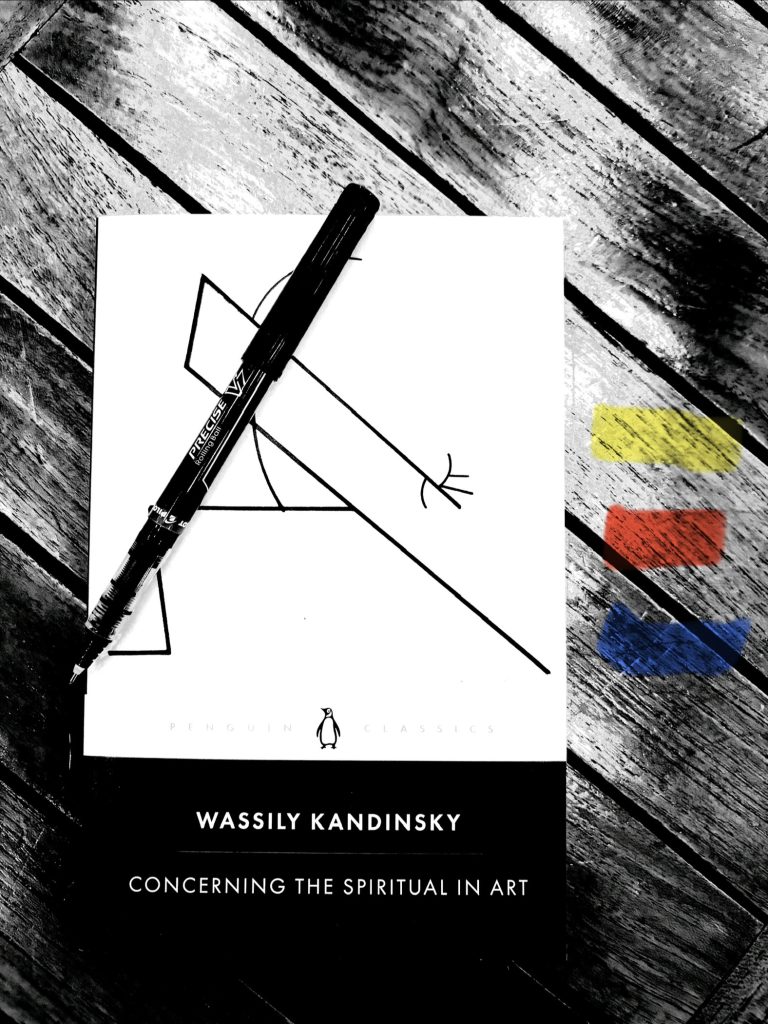
Indeed, Kandinsky was drawn to Landauer’s work. He liked the latter’s belief in the mystical element of every human being, and his encouragement for everyone to be true to themselves, even when it meant going up against long-established social norms. From the time he attended the opera in Moscow onward, Kandinsky endeavored to paint what came into his mind, often in incredibly intangible, abstract, and amazing ways. And, I’ll add, Kandinsky would later conclude in his 1912 book, Concerning the Spiritual in Art, that, in the spirit of anarchism, “there is no ‘must’ in art because art is free.”
In 1901, Gustav Landauer published a remarkable essay entitled “Anarchic Thoughts on Anarchism,” in which he celebrates
those who accept the challenge to create their own chaos in order to discover their most authentic and precious inner being and to become one with the world in a mystical union. What these men will be able to bring to the world will be so extraordinary that it will seem to have come from a world altogether unknown. Whoever brings the lost world in himself to life—to individual life—and whoever feels like a true part of the world and not a stranger … will live with each other in solidarity—as men who belong together. This will be anarchy.
One of those men of the sort Landauer is alluding to was Vasily Kandinsky. Heeding Landauer’s call to emotional and artistic arms, he continued to develop the “dot” that had become his art. Gradually, Kandinsky moved further and further away from what everyone else around him was doing with their own artwork, abandoning the accepted approach of painting people, landscapes, et cetera. Heartfelt authenticity and honest emotion were more important to him than subject. And he did not, at the time, win any popularity contests or awards; on the contrary, at his early art shows, it was common for visitors to spit on the abominations they imagined his abstract paintings to be. Nevertheless, Kandinsky continued on apace and walked his own way.
In 1912, at the age of 46, Kandinsky brought Landauer’s “lost world” to life when he displayed in a gallery what many consider to be the first abstract painting ever presented publicly: Untitled (First Abstract Watercolor). As he would later describe his discovery of what was possible when he abandoned objects and painted only the abstract expression of his emotions, “I found the key to the puzzle.”
_by_Wassily_Kandinsky.jpg)
Seventeen years ago this month, in September 2009, the Guggenheim Museum in New York put on a powerful retrospective of Kandinsky’s work. Writing in the New York Times, art critic Roberta Smith observed,
The Russian avant-gardist [Vasily] Kandinsky—who dressed like the college professor he had trained to be and sounded like a mystic when he wasn’t thinking like a scientist … is the angel in the architecture at the Guggenheim; he’s part of the bedrock. The circling ramp of [Frank Lloyd] Wright’s rotunda was surely designed with that Russian’s swirling, unanchored abstractions in mind. Kandinsky’s precarious, ever-moving compositions suggest that he never met a diagonal he didn’t like; Wright obliged with a museum on a perpetual tilt.
In my own case, the “dot” that catalyzed my now four-and-a-half-year-long dedication to dignity was the Russian invasion of Ukraine. As I shared in the pamphlet “A Revolution of Dignity,” when Russia invaded on February 24, 2022, it had a huge emotional impact on me, and I felt incredibly helpless in the face of the horror. Stories about Russian war crimes in Bucha dragged me down even further. Within a few days, I realized I had sunk into despair. Unsure of what to do, I started studying. While I knew a fair bit about Russian history (my major at the University of Michigan), I had next to no knowledge of Ukrainian history. Before long, my studies led me to Ukraine’s 2014 Revolution of Dignity. Almost immediately, I knew what to do: while I wasn’t going to single-handedly alter the course of history in Ukraine, I could change history here at home by making dignity a big part of my work. And by turning dignity into a local reality, we could begin to slowly but surely transform the world around us. As Kandinsky noted when he entered the realm of the abstract, I, too, felt as if I had “found the key to the puzzle.”
I’ve taught about dignity many times now over the past four years, and, more recently, four or five times in the past few weeks. Yet, as Kandinsky says, “not everything is visible and tangible, or—to be more explicit—under the visible and comprehensible lies the invisible and incomprehensible.” It took me a while to make the connection, but as I was recently preparing to teach it again—this time to a leadership cohort here in the ZCoB (Zingerman’s Community of Businesses)—I had one of those sudden epiphanies of the kind that Kandinsky had in the opera house in Moscow 130 years ago. It struck me that dignity is not just an important element in the work of any organization—company, community, country. It’s actually far, far more significant than that: dignity, as I said above, is to leadership work what primary colors are to painting. And, as Kandinsky writes in Concerning the Spiritual in Art, “to harmonize the whole is the task of art.”
To confirm my new reality, I ran down the list of philosophies and approaches we practice here: Servant leadership. Stewardship. Diversity. Open-book management. Customer service. (I could go on for pages.) To do any of them in a meaningful, heartfelt way, one must begin with a base of dignity. While you can use dignity to make other leadership “colors,” without it, none of them really work in a down-to-earth, difference-making way. To make the point even more elemental, dignity, as I share in the “Why Democracy Matters” pamphlet, is a primary means of holding our own in these challenging times we’re living in. Without dignity, we cannot have democracy.
Why, though, are primary colors so important? Science Insights explains,
Primary colors matter because they are the smallest set of colors needed to produce the widest possible range of other colors through mixing. This principle underpins everything from how your eyes interpret the world to how every screen, printer, and paint set generates millions of distinct hues from just a few starting points. Without primary colors, reproducing the full spectrum of visible color would require an impractical, possibly infinite, number of individual pigments or light sources.
Thinking about dignity as a primary color, then, has helped me understand—and communicate—its critical nature. Just as all other colors are essentially created from primary colors, I see that pretty much everything we teach in the ZCoB actually evolves out of dignity. Over time, I will continue to assimilate and internalize this approach until it simply becomes the way I see the world. As Amy Sherald, whose paintings’ flat backgrounds have been compared by artsXhibit to Mark Rothko’s, says, “Color is my natural language.”
In the spring of 1925, Kandinsky showed a new painting that we could consider the crux of this essay—it’s all about primary colors. Entitled Yellow-Red-Blue, it stands 50 feet tall by 80 feet wide, and it now hangs in the Centre Pompidou in Paris. If you remember what you learned in art class as a kid, yellow, red, and blue are the three primary colors. (Though there are, I know, other color models now, I’m still going to go with this one because it’s what I learned growing up and because it fits Kandinsky’s 101-year-old painting.) Discussing the artwork, the magazine Singulart says,
Yellow-Red-Blue is a masterpiece, and describes the very heart and purpose of Kandinsky’s artistic vision. It’s not a painting, it’s an experience. This work is special because the bold primary colors, the intricate form balance, and the emotional depth in them all work together to make this one truly special. If you are one of the seasoned art lovers or just a lover of pretty colors, Yellow-Red-Blue offers you a place to sit and have you feel something, because really that’s what art is all about, en fait n’est ce pas?
Teaching, practicing, and internalizing the idea of dignity as a primary color, can, I believe, do much the same for us. As Kandinsky did with Yellow-Red-Blue, we have long committed to making coming to Zingerman’s “an experience.” It gives us a place to sit, helps us feel at a deeper level, and then inspires us to take action in ways that are more meaningful, empathic, and effective than ever before.
(Speaking of thinking in colors—the staff at the Centre Pompidou offer the idea that Yellow-Red-Blue “is a balance of opposed but complementary elements. Two parts seem to confront each other.” Perhaps it’s no coincidence, then, that this is a confrontation playing out in the world today: Blue and yellow are the colors of the Ukrainian flag. What’s the Russian flag? Red.)
With all this in mind, what does it actually mean to embody dignity? These are the six elements I lay out in the pamphlet “A Revolution of Dignity”:
1. Honor the essential humanity of everyone we work with.
2. Be authentic in all our interactions (without acting out).
3. Make sure everyone has a meaningful say.
4. Begin every interaction with positive beliefs.
5. Commit to helping everyone get to greatness.
6. Create an effective application of equity.
There is, of course, far more on each of these six elements in the pamphlet—and, in a sense, I suppose that figuring them out is my own work of art. As Kandinsky writes,
The true work of art is born from the “artist”: a mysterious, enigmatic, and mystical creation. It detaches itself from him, it acquires an autonomous life, becomes a personality, an independent subject, animated with a spiritual breath, the living subject of a real existence of being.
I’ll just add here that, when I wrote them all out on paper, my commitment to myself was to practice the six elements above for every single person I came into contact with. At work. At home. For our customers, co-workers, and community members. For people I’m fond of, and also those with whom I’m very frustrated. Practice, we know, doesn’t actually “make perfect,” but it does, it turns out, “make permanent.” The more I enact the six elements of dignity, the more they become integrated into who I am as a human. Again, as Kandinsky notes,
The spirit, like the body, can be strengthened and developed by frequent exercise.
In an essay about Kandinsky, art historian Rose Carol Washton Long writes,“For a utopian thinker, involving the public to bring about change is critical.” Similarly, that’s what I’m doing here by sharing my reflections on this most recent “dot” in my philosophical development—in the hope that they will spark a quiet revolution of dignity within our own communities, becoming, in the best possible way, the metaphorical equivalent of a primary color.
Renée B. Miller from the Denver Art Museum points out, “For Kandinsky, color also had the ability to put viewers in touch with their spiritual selves.” I haven’t tried my hand at painting since I was probably 10 (yes, I know—no time like the present), but I have pushed myself over the past few years to become more vulnerable by sharing some poetry. Here is one such exploration:
Color, it’s possible, is the perceptual quality of light.
Dignity, perhaps, is then the perceptual quality of doing right.
While much of the world endeavors to do without dignity, we don’t need to let that stop us.
A tiny bit of courage can change history.
It all starts with a dot.
Perhaps it will become my primary message:
We cannot but begin with color.
In his aforementioned 1926 tome, The Point and Line to the Plane, Kandinsky writes,
Today we stand on the threshold of a time in which one—but only one—step leading into the depths is gradually coming more and more to the fore. In any case, we have an inkling of the direction in which our foot must seek the further step. And that is the salvation.
That direction, I want to suggest, is to dive ever more deeply into dignity. This is indeed, now more than ever, my primary message.
It’s clear to me that much of the country has concluded that, given the uncertain state of things, it’s smarter and safer to simply withdraw from the world and wait it out. Here in the ZCoB, by contrast, we dig deeper into dignity. And the more we do so, the better the lives of those around us are. As Mark Rothko said nearly a century ago, “It is really a matter of ending this silence and solitude, of breathing and stretching one’s arms again.”
In the epilogue of “A Revolution of Dignity in the Twenty-First Century Workplace,” there’s a quote from a Ukrainian woman named Anastasiia. I came across it in historian Marci Shore’s remarkable oral history of the demonstrations on the Maidan central square in Kyiv, which led up to Ukraine’s Revolution of Dignity in 2014. As I assess the current state of our world, Anastasiia’s words hit me in the heart every time I read them:
Everyone needs to decide. … It’s necessary to believe, and it’s necessary to act. Today it seems to me a time of responsibility for every person, every person concretely. Every person is responsible for our future. Every one. Every person needs to decide.
Kandinsky, who spent much of his childhood in the Ukrainian city of Odessa, wrote in Concerning the Spiritual in Art that “every work of art is the child of its age.” So, if Rothko is right that the child begins with color, then let’s make the art of our age with the powerful primary colors of dignity.
Here’s to good things to come.