
And why we’ll have a hard time leading inspired lives without it
What would you do if your intuition gave a strong indication that you ought to write an article about the import of intuition?
Me, I could pretty quickly come up with a couple hundred reasons to take a pass—in my case, I’m certainly not a scientist who studies the subject for a living, nor would I claim to have done any kind of world-class scholarship. Nevertheless, after considering it for a couple of days, I decided to honor my intuitive insight and give it a shot. The essay that follows includes what I’ve figured out so far. There’s more to come down the road, I’m sure, but for the moment … let’s get in-to-it.
This is not, by the way, the first time I’ve reflected on the concept of intuition. I wrote a bit about it in Secret #39, “Creating Creativity,” in Managing Ourselves. Neither, though, is it an area in which I’m any sort of expert. Which, of course, is the nature of so many intuitive ideas—something just tells us it’s time to engage. All too often, however, our lack of expertise, a deficiency of data, and/or uncertainty about a subject make taking action on our intuitive feelings feel far too awkward. Learning to honor intuition is, then, in part, learning to lean in and move forward anyway. It’s very much what Australian music writer Anna Stich describes:
By practicing to listen to our intuition, we gain the power to understand ourselves and attain an easier access to our creativity. … Often, we have to be confronted with situations that we are not comfortable with or through which we could not expect to really see how we can change our lives for the better.
Speaking of changing our lives for the better, you might well already know the name Robert Greenleaf. He’s rightly revered as the guy who, in 1977, literally wrote the book on Servant Leadership. I’m on the list of those who greatly appreciate Greenleaf’s good work—Servant Leadership has long been at the core of the ZCoB’s (Zingerman’s Community of Businesses’) leadership philosophy, and it has, without question, changed our lives here in wonderful ways.
Buried inside the 340 pages of the book—and not really directly related to Servant Leadership—is this tiny tidbit of amazing wisdom:
Unless one trusts intuitive insights, one doesn’t get them. … Unless insights are acted on, they don’t speak with assurance.
To be honest, the first time I saw those sentences many years ago, I had to read the lines two or three times before I finally understood them. I’ve tried to honor and live them ever since. Which is a big part of why, when I have an intuitive indication that I ought to be doing something, I’ve taught myself to tune into it more closely and, wherever possible, to put it into action. Sure enough, the more I follow Greenleaf’s advice, the more intuitive insights I get, and the more I’m able to act on them. With each passing year of practice, they speak to me with ever greater assurance. This essay is merely one more piece of positive evidence.
Nearly half a century after Greenleaf’s book came out in 1977, Servant Leadership now seems a well-established practice among progressive leaders. Turning back the clock, though, that was not always the case. What’s now widely accepted was once considered “way out there,” weird, or just plain wrong. Like all creative, cutting-edge ideas, Servant Leadership emerged not from extensive data collection but rather from Greenleaf’s intuitive sense that he should write about what he knew in his heart was right. Intuition, it turns out, was an essential ingredient. And as I’ve said so many times over the years in writing about food, if we want to make a really wonderful finished dish, we need to begin with great ingredients. In the context of leadership, one of those “ingredients” is, indeed, being in touch with our intuition.
Thankfully for the rest of us, Robert Greenleaf took his own advice and trusted his intuition. The world got Servant Leadership; all Greenleaf got, at least in the beginning, was anxiety. In the 1970 essay “The Servant as Leader,” a short piece that would pave the way for the publication of the full book seven years later, he shares his uncertainty and the inevitable struggle that almost anyone acting intuitively embraces in order to bring their idea into existence:
As I ponder the fusing of servant and leader, it seems a dangerous creation: dangerous for the natural servant to become a leader, dangerous for the leader to be servant first, and dangerous for a follower to insist on being led by a servant. There are safer and easier alternatives available to all three. But why take them? As I respond to the challenge of dealing with this question in the ensuing discourse I am faced with two problems. First, I did not get the notion of the servant as leader from conscious logic. Rather it came to me as an intuitive insight. … Serving and leading are still mostly intuition-based concepts in my thinking.
Greenleaf, who was referred to by one executive as the company’s “kept revolutionary,” worked at AT&T in Terre Haute, Indiana, for more than four decades. Over the years, he repeatedly stood up for what he believed was right and refused to get caught up in the widely accepted status quo. He listened with open ears and observed carefully in search of ways to make a better world, writing that “caring for persons, the more able and the less able serving each other, is the rock upon which a good society is built.”
The same can be said, I’m confident, for companies as well as countries. That path was not then, nor is it now, the easy way to work. But as Greenleaf noted, “Awareness is not a giver of solace—it is just the opposite. It is a disturber and an awakener. Able leaders are usually sharply awake and reasonably disturbed.” Part of what sets such effective leaders apart is that, as he says, “they are not seekers after solace. They have their own inner serenity.”
Speaking of those who are “sharply awake and reasonably disturbed,” this past weekend, singer, songwriter, guitarist, and activist Tom Morello of Rage Against the Machine, a Rock & Roll Hall of Fame inductee, performed at the Power to the People festival in Columbia, Maryland. The show took place, by coincidence, on the 59th anniversary of folk singer Woody Guthrie’s death in 1967. In the spirit of Guthrie—probably the most famous figure of musical resistance in the 1930s and ’40s—Morello announced from the stage, “Every act of art is an act of resistance.”
Tom Morello’s art is, of course, music—which Princeton professor Elizabeth Margulis, author of Transported: The Everyday Magic of Musical Daydreams, calls “an intriguing window into what makes us tick.” Great music, like great leadership, is always interwoven with intuition. As Margulis makes clear, “Intuitive associations … aren’t distractions. They’re a core part of how we make meaning from music.” And also, it seems, how some of the best music is made.
On a related note of music and meaning … 65 years ago last week, on the 29th of September, 1961—back when Robert Greenleaf would have been celebrating his 57th birthday in Indiana, and neither Tom Morello nor Elizabeth Margulis had yet been born—the New York Times ran the second of what would eventually turn into many hundreds of articles about a young, Minnesota-born musician who, at that point, had hardly been heard of by anyone outside the Greenwich Village folk scene. The piece was bordered by ads for comedian Phil Silvers and the Leningrad Kirov Ballet visiting from the Soviet Union. In the spirit of history regularly rhyming, the Times’ front page that day featured articles about tensions in the Middle East and more tension still between the Soviet Union and the West. High gas prices were on the bottom of the page, as was an article about the newly approved integration of Atlanta restaurants taking place without incident.
The article that caught my attention, though, was placed further back in the paper, at the top of page 31. Written by Robert Shelton (born Robert Shapiro in my hometown of Chicago back in 1926 and influenced by the widespread anti-Semitism of the era to change his name to something “less Jewish”), it began:
A bright new face in folk music is appearing at Gerde’s Folk City. Although only 20 years old, Bob Dylan is one of the most distinctive stylists to play in a Manhattan cabaret in months.
Resembling a cross between a choir boy and a beatnik, Mr. Dylan has a cherubic look and a mop of tousled hair he partly covers with a Huck Finn black corduroy cap. His clothes may need a bit of tailoring, but when he works his guitar, harmonica or piano and composes new songs faster than he can remember them, there is no doubt that he is bursting at the seams with talent.
Mr. Dylan’s voice is anything but pretty. He is consciously trying to recapture the rude beauty of a Southern field hand musing in melody on his porch. All the “husk and bark” are left on his notes and a searing intensity pervades his songs.
Dylan is widely accepted today as one of the all-time greats when it comes to actualizing intuition in meaningful, magical, and practical—but still seriously poetic—ways. At the time, though, he was just a 20-year-old, two years out of high school, with barely two bits to his name, trying to make a living from his music. Anyone who studies Dylan’s style can see it was not conceived in some corner office on Madison Avenue—as many musicians of that era were—by some big-business music executive. As Shelton had written in a much smaller piece in the Times two months earlier, about WRVR’s live radio music show, “Among the newer promising talents deserving mention are a 20-year-old latter-day Guthrie disciple named Bob Dylan, with a curiously arresting mumbling, country-steeped manner.”
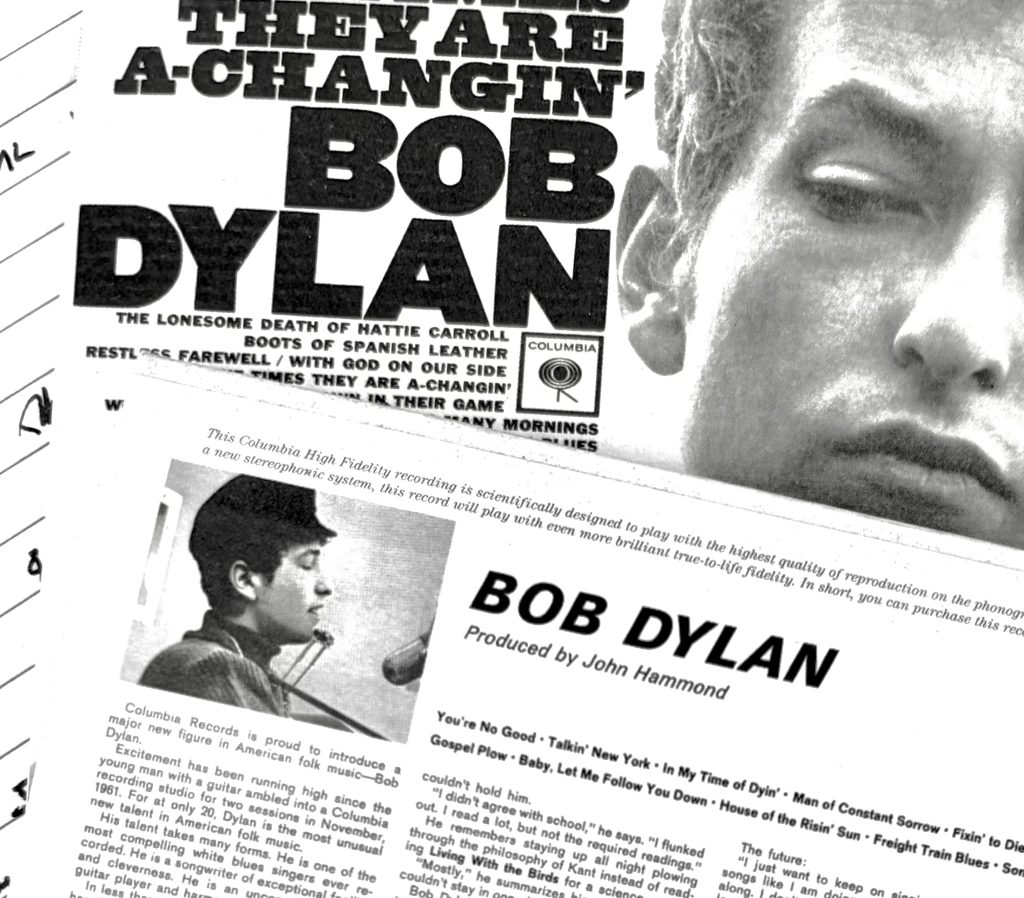
Later, in the fall of ’61, Dylan would go into the studio to record his first album. The record would be released the following winter, in mid-March 1962 (almost exactly 20 years before we opened the Deli in ’82), with the simple title Bob Dylan. Acting, it seems, on intuition, Dylan abandoned the typical, far safer path of recording his best-known and most oft-played tunes for the record. Instead, he opted to include mostly songs he’d never even played before in public. One of the two originals on the album was “Song to Woody,” a tribute to the great singer of protest songs who’d inspired him so much, and whom, 65 years later, Tom Morello and his fellow musicians would honor by playing their Power to the People show on his birthday. The podcast Deep Dive Archive says it’s “Song to Woody” that “ties the whole [Bob Dylan] album together,” demonstrating the then-novel idea that one could bother to pay homage to old folk tunes and, at the same time, write new ones as well.
As with nearly all of Dylan’s output, his intuitive sense of what was right and true drove the work. As he told the Wall Street Journal four years ago this fall, “I walk into things intuitively when I’m most likely not looking for anything.” Artist Vasily Kandinsky, we know, heard music and saw colors. Dylan was, it seems, almost the inverse. Daniel Goldmark, the head of Case Western’s Center for Popular Music Studies, talks about “paintings in [Dylan’s] mind that have turned into songs.” You can see the impact of intuition throughout Dylan’s music—he constantly grabs ideas and images from other sources and puts them together in seemingly out-of-context but compellingly creative ways.
Dylan biographer Richard Thomas, who went to grad school here in Ann Arbor back in the mid-’70s and later authored the book Why Bob Dylan Matters, says, “Bob Dylan truly is a poet whose song is part of the poetry.” His lyrics are loaded with strangely hypnotic phrases, like “Leopard-Skin Pillbox-Hat” (the actual hat belonged, it seems, to Edie Sedgewick) and “Honolulu, San Francisco, and Ashtabula”—three places his then agent-collaborator Ellen Bernstein had lived in, or was going to visit, at the time Dylan was writing “You’re Gonna Make Me Lonesome When You Go” for Blood on the Tracks in 1974. In a 2004 interview with 60 Minutes, journalist Ed Bradley asked a 63-year-old Dylan how he had written his early songs. His answer, essentially, was intuition: “I don’t know how I got to write those songs. Those early songs were almost magically written.”
Without an intuitive sense of what was right and what needed to be said, it seems highly unlikely that Dylan would have broken so many social norms in ways that no mainstream music executive would ever have suggested. He wrote “The Ballad of Emmett Till” in 1962, in a still-segregated America, about the infamous lynching seven years earlier of the Black Chicago teenager who’d gone down to spend his summer holiday with relatives in Mississippi. Eighteen months later, he recorded “The Lonesome Death of Hattie Carroll,” about the killing of a 51-year-old Black barmaid named Hattie Carroll by a wealthy white man less than half her age.
On the 1st of May, 1963, Dylan, a few weeks shy of his 22nd birthday, sat for an awesome half-hour-long interview with the great journalist Studs Terkel for Chicago’s WMFT radio. In the intro, Terkel describes Dylan as a “folk poet,” a “young Huck Finn, but living in the 20th century.” The two have a terrific conversation (unlike so many of Dylan’s early interviews, in which he uses wit, humor, and sarcasm to mess with the establishment interviewers), interspersed with Dylan playing songs, including a lovely version of “A Hard Rain’s A-Gonna Fall” that Terkel talks Dylan into performing live on the show. About two-thirds of the way through their discussion, out of the blue, Dylan decides to play the first-ever recorded version of “Boots of Spanish Leather,” a song that would later go on to be considered one of his best (and this initial version is, to this day, thought to be exceptionally good). Both of these songs appeared the following February, when Dylan’s appropriately titled album The Times They Are A-Changin’ was released. As Maria Popova would write many years later in The Marginalian,
Like many creators, Dylan values that unconscious aspect of creativity far more than rational deliberation, speaking to the idea that the muse cannot be willed, only welcomed.
No one can know, of course, the way that anyone else’s creativity really works, but, as I said above, it sure seems as if all compelling creative work is initiated intuitively. With that in mind, I love what writer Elif Shafak has to say in this interview with Goodreads:
Every time I start a new novel I do a lot of research. I read on the subject as much as I can. As a novelist I think I have no right to be lazy. However, after reading for weeks and months, there comes a point when I stop reading and start writing. From that point onward, I do not write like a researcher who is guided by rationality or intellectual accumulation. I write with intuition. To me intuition is more important than information.
In another interview conducted a couple of years later with F(r)iction,Shafak explains,
There are two different ways of writing a novel. One is more like engineering: structure, details, blueprint. The second is you’re drunk. You don’t know what you are doing but you have a strong passion and intuition and you just follow it. My style has always been the latter. I do a lot of research. I take that piece very seriously, with a lot of discipline. But that aside, I follow my intuition and let the characters guide me. At the moment I don’t know what I am doing. All I know is I am writing.
Shafak’s style is, I would say, very similar to my own. It’s also a far cry from what I used to do 40 years ago. Trained to write history term papers in school, I would always begin with good intentions and a logically thought-out outline, then focus on developing an opening statement and a clear conclusion. All these years later, it’s almost the opposite: good intentions are great, but, for me, it’s intuition that sets the pace. I start out with an idea, a commitment to coming up with practical insight that others can benefit from, a deadline, and not a whole lot else. As Shafak does—and as did Dylan, who read books and listened to music voraciously, saying later, “I’m digging through history to find useful information for my craft”—I start by studying. I’m definitely not drunk when I write, but, as with Shafak, it’s safe to say I don’t really know where I’m going when I sit down to get started. In fact, most of the figures mentioned in this essay were not even on my mind when I began. I’ve learned to let myself be led by research, random association, and an intuitive sense of how to weave them all together into workable, practicable pieces.
Dylan’s 1965 classic “Subterranean Homesick Blues” sort of sums up the uncertainty of acting, as he has done for decades now, on intuition. It’s an encouragement to tune into what’s in our hearts, and to let go of the belief that we should wait for some sort of data-driven certainty before we get going:
You don’t need a weatherman
To know which way the wind blowsGet sick, get well
Hang around a ink well
Ring bell, hard to tell
If anything is goin’ to sell
While everyone has intuition, most of us (me included) are raised, consciously or unconsciously, to block it out. The insights are inside us, but we’re taught to remain indifferent to their invitations. Matt Elliott, the remarkable British-born, French-dwelling dark-folk musician I wrote about last week (scroll down to the bottom), sings,
I was trying to talk to you
But you couldn’t hear
I was trying to explain to you
But you wouldn’t listen
If I wonder aloud why we would want to learn to tune into our intuition more effectively, it’s quite simply because intuition ignored does not a better world make. To the contrary, it cuts us off from some of our best insights. As the BBC noted in the spring of 2022, “Intuitions are an essential part of our decision-making toolkit—that should be ignored at our peril.” Regarding what I wrote last week about dignity as a primary color, I feel confident saying that Vasily Kandinsky did not abandon his successful career as an attorney to become an artist at the age of 30 because he was confronted by “compelling data” proving that painting was a preferable career path to practicing law.
Without intuitive insight, we would definitely never have opened the Deli—we certainly didn’t do any marketing studies, and all the data others were offering actually said we’d be dead in the water in a matter of months. The general wisdom was that Ann Arbor wouldn’t support a deli (a dozen had closed in the previous decade), people told us it was a terrible location (six blocks from downtown), and there’s still no convenient parking to this day. Dataless on the corner of Detroit and Kingsley Streets, we opened the Deli on the morning of March 15, 1982.
Later that evening, a 40-year-old Bob Dylan was inducted into the Songwriters Hall of Fame.
None of this is, to be clear, encouragement to act recklessly or unthinkingly. Honoring intuition does not require us to be reactive. Rather, the key is to tune in, listen, look, and feel what’s in our hearts and our guts, and then get grounded in good ways before deciding—again, without certain proof—how we’re going to move forward. There are three steps that, it seems to me, come into play with this work:
1. Access and gain awareness of what our intuitive feelings, ideas, and insights actually are. There are dozens of ways to do this; I write about a bunch in both Secret #31, “Managing Ourselves,” and Secret #39. Journaling, poetry, painting, meditation, and meaningful conversation with friends can all help. The “hot pen” technique we teach with visioning is, in fact, a way to invite intuitive insight while walling off the overthinking parts of our brain (which can come back to converse later—just not at the vulnerable, let-it-all-hang-out beginning). As Dylan observed many years ago, “The best songs to me—my best songs—are songs which were written very quickly. Yeah, very, very quickly.”
This also relates to Angela Duckworth’s well-taken point about the import of where we hang out and whose input we take in. As Maria Popova writes, “There are, in my experience, two fundaments of the creative life: putting yourself regularly in the path of wonder and getting out of your own way in order to receive what you encounter there.” And that is, indeed, what seems to have helped Dylan: by reading and listening widely, and later moving to Manhattan, he successfully immersed himself in a series of intuitive ecosystems. As writer Richard Stengel notes,
In the nineteen-sixties, being intuitive was indispensable. Hipsters were in touch with their intuitive side; bankers and bourgeois suburbanites were not. Being intuitive meant that one had a gift of insight, a kind of natural perceptiveness that was not derived from experience. Intuition was better than knowledge.
In an interview with the New York Times from June 2020, Dylan talks about how all of this is integrated into the intuitive way he works:
It’s the kind of thing where you pile up stream-of-consciousness verses and then leave it alone and come pull things out. … The songs seem to know themselves and they know that I can sing them, vocally and rhythmically. They kind of write themselves and count on me to sing them.
One must “stay in the unconscious frame of mind to pull it off,” Dylan says elsewhere, “which is the state of mind you have to be in anyway.”
2. Ponder, reflect on, and study those intuitive thoughts further. Processing helps crystallize and clarify. As Dylan explains in his interview in the intriguing book Songwriters on Songwriting,
There’s two kinds of thoughts in your mind: there’s good thoughts and evil thoughts. Both come through your mind. Some people are more loaded down with one than another. … And you have to be able to sort them out. … You must get rid of all that baggage. … It’s important to get rid of them thoughts. … Then you can do something from some kind of surveillance of the situation. You have some kind of place where you can see it but it can’t affect you. Where you can bring something to the matter, besides just take, take, take, take, take.
And, after that, find ways to share those thoughts with the sort of good people Angela Duckworth advocates that we spend time with. The kind of folks Julia Cameron, author of The Artist’s Way, calls “believing mirrors”—people who believe in us and can deliver freethinking, focused feedback without leaving us feeling crushed.
3. Stay determined to gently hold onto our hunches for a good long while. Many people have ideas, and even speak them aloud—but when they meet with resistance or they lose focus, they forget all about them. The best course of action, though, is actually to sit with our ideas for a good while—weeks, months, even years.
To wit, I had a strong belief that we could do something along the lines of our Perpetual Purpose Trust (PPT), but implementation was anything but instantaneous. To the contrary, it took 10 years—and leaning into a lot of resistance—to get to the positive outcome we eventually arrived at. Data was not what drove the idea; there might have been only a dozen—or, at most, two dozen—similar models in the country at the time. Yet the PPT is an approach that’s beautifully aligned with Robert Greenleaf’s belief in serving the community: essentially, it’s Paul and I gifting the Zingerman’s brand to itself so that it can never be sold—meaning that in 2041, on the 100th anniversary of Dylan’s birth, the ZCoB will still be here, locally owned and run as it has been since we opened in 1982.
The understanding that intuitive feelings and ideas can take years to come to fruition is evident in the excellent writing of author Steven Johnson, who explains,
Most hunches that turn into important innovations unfold over much longer time frames. They start with a vague, hard-to-describe sense that there’s an interesting solution to a problem that hasn’t yet been proposed, and they linger in the shadows of the mind, sometimes for decades, assembling new connections and gaining strength. And then one day they emerge into the light of day: sometimes jolted out by some newly discovered trove of information, or by another hunch lingering in another mind, or by some internal association that finally completes the thought. Because these slow hunches need so much time to develop, they are fragile creatures, easily lost to the more pressing needs of day-to-day issues. But that long incubation period is also their strength, because true insights require you to think something that no one has thought before in quite the same way.
Part of holding course like this means we have to be willing to walk our own way—to hear the resistance but, with dignity in every direction, stay true to our own path. The work here is not to instantly get everyone else to agree that your intuitive insight isn’t insane. Rather, as marketing maven Seth Godin says so well in a piece entitled “The intuition vs. analysis conundrum,”
The challenge is not to somehow persuade those in search of soundness to change their minds. The challenge is to do enough of a gut check to decide whether you should defend your instinct. And then do it.
Effective application of intuition, it also seems clear, requires sensitivity, awareness, and care for people whom, per Robert Greenleaf’s wise words, we have the honor to serve. As Irish-Australian author Bernadette Jiwa says in Hunch, to be effective with intuitive ideas, we must embrace “empathy, creativity, trust, and uncertainty.”
In a sense, I’ve realized this work is very related and relatable to anarchism. As South African scholar Theresa Jane Hardman wrote in the Journal of Creativity five years ago this fall, in a piece entitled “Understanding Creative Intuition,” “A fluid and open approach to reality enables more anarchic ways of thinking.” And in his 60 Minutes interview, Dylan does, albeit ironically, refer to his former rebellious public image as “the Archbishop of Anarchy.” In her biography of anarchist activist Emma Goldman, Vivian Gornick looks back 100 years to a precursor of Tom Morello and the Power to the People performances last weekend:
Emma Goldman made obvious something that we know intuitively, but forget in the bustle of incremental social change: revolutions are made by human beings who realize who they are and what they want. The struggle of people to find their connection with others through community, to realize who they can be in the face of tyrannical institutional suppression, and the power that can come when we bypass the mediated political systems that are offered and take our power back. To actually make a break with the past, not just evolve past its memory.
So what, then, does all of this say? To me, that intuition is essential—and that it’s at its most effective when we have good people to filter our feelings through. Although intuition may not mean immediate results, it’s well worth holding onto it, letting it tap around the edges of our ecosystems, and continuing to explore opportunities in the understanding that many hunches have long-term potential. Without intuition, we’ll almost certainly fail to make the mark we might well make, and to have the resulting positive impact on others. As Dylan says, “When you feel in your gut what you are and then dynamically pursue it—don’t back down and don’t give up—then you’re going to mystify a lot of folks.”
On September 29, 1990, 29 years to the day since Robert Shelton had written the big New York Times article that broke Bob Dylan to the wider world, Robert Greenleaf passed away peacefully in Terre Haute. He was 86 years old.
Backing up a bit, it turns out that Bob Dylan had played a show in Robert Greenleaf’s Indiana hometown 58 years ago next week, on October 14, 1978—just one year after Servant Leadership hit bookstore shelves. I suppose it’s unlikely that Greenleaf, then 74, would have attended, but about 9,000 other folks did pack the auditorium in the Hulman Center that evening. “The Times They Are A-Changin’” was smack-dab in the middle of the set. The final number was “Forever Young,” which closes with lines that could have come, perhaps in less poetic form, from Robert Greenleaf himself:
May God bless and keep you always
May your wishes all come true
May you always do for others
And let others do for you
May you build a ladder to the stars
And climb on every rung
May you stay forever young …May your heart always be joyful
May your song always be sung
May you stay forever young
P.S. Want to learn more about getting in touch with your own intuition? ZingTrain’s “Managing Ourselves” seminar is coming up October 28–29. The ZingTrain crew says that if you use the code ARI, you’ll get 30% off! And if you come to town, you can kick off the visit by being part of the “Why Democracy Matters” pamphlet event at the Roadhouse on the evening of October 27.