
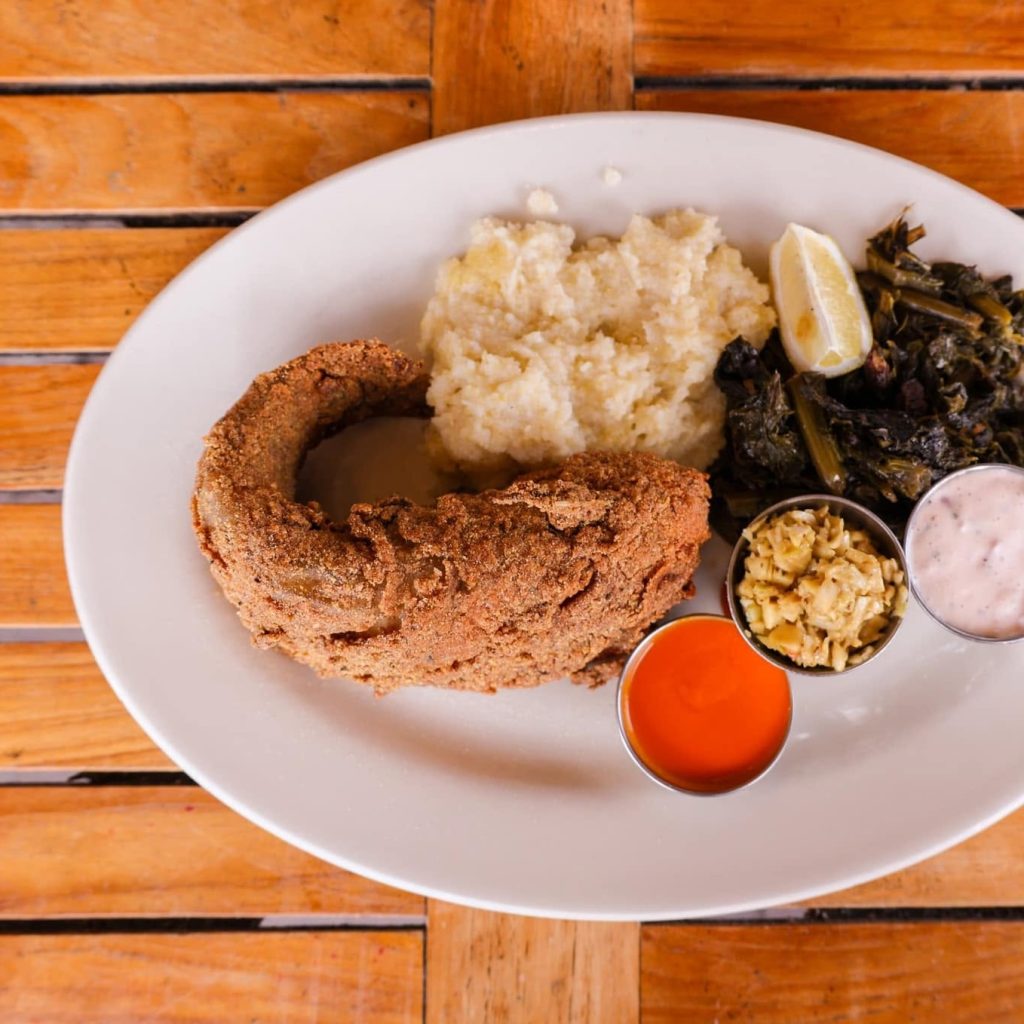
A terrific taste of the American South on Ann Arbor’s west side
Bruce Springsteen, who covered Creedence Clearwater Revival’s “Fortunate Son” when he played the Power to the People festival in Maryland two weeks ago, once declared, “A dream of life comes to me, like a catfish dancing on the end of the line.” Some Roadhouse regulars are so energized by the whole fried catfish that just seeing it back on the menu—as it is this month—helps inspire their dreams. Smiles and nods abound when the cat comes back up to bat!
Fried catfish has been a steady menu item at the Roadhouse since we opened back in 2003, but it’s on my mind this week because, as I mentioned above, I was just down in Memphis at the Southern Foodways Symposium. It’s only by attending the conference many years ago—and making regular visits to Taylor Grocery in the North Mississippi town of Taylor—that we found our source for catfish: a quality-focused fish farm in Yazoo City, Mississippi.
The complete story of this catfish, though, actually started for me in a wholly unexpected place—with my friend Peggy Markel. I’d met Peggy traveling in Italy ages ago, and she’s been actively involved in Zingerman’s Food Tours to Tuscany, Morocco, and more for longer than I can remember. I never knew it until our conversation turned to catfish one day—right around the time we were getting ready to open the Roadhouse—but it turned out that, although Peggy splits her time between Boulder, Colorado, and Italy, she was actually born and raised in North Alabama. And her dad, “Uncle” Joe Burroughs, she told me, had cooked catfish almost every Friday night in the small town of Albertville, where she was raised. As she explains:
My father was creative and artistic. He expressed himself best as a gardener and cook. … He had a passion for frying catfish. He always wanted his own fried catfish joint. He was famous down there. People came from far and wide to our house for some of “Uncle Joe’s famous catfish.” It was a hot ticket. My dad had a barbecue pit in the backyard that he rigged a gas line to. He would heat a deep, oblong cast-iron skillet full of Mazola oil. Soon after, those delectable filets, lightly dusted with cornmeal from being shaken in a paper sack, would be sprinkled with the “secret ingredient” and expertly slipped into the simmering hot oil. We never had enough money to realize his dream of his own “Catfish Café,” but we had one, anyway, every Friday night at our house, with people going crazy over crispy fried catfish.
You might have noticed the phrase “secret ingredient” in that lovely description. The secret, in fact, was garlic salt—certainly not something I typically use much of in my cooking these days. But if Peggy’s dad was making great catfish with that much success for so long, it seemed sort of silly not to try out his tip. And to this day, that’s what we do!
If you haven’t yet had this tasty Southern treat, the fish comes out to the table looking really great, with its crisp, cornmeal-crusted tail curled around a little pile of freshly made hush puppies, along with sides of Roadhouse coleslaw, homemade tartar sauce, and hot sauce. In tribute to Peggy’s dad, it’s been called “Uncle Joe’s Fried Catfish Platter” ever since we opened. Uncle Joe Burroughs passed away in 2008, and his story strikes me as capturing the essence of what we do here—the connection among good people, good food, community, and caring about those around you. He never got to have his own restaurant, which makes me feel all the more honored that we can pay homage to him by putting his name on our menu here in Southeast Michigan.
As a little postscript to this tale, one of the fascinating things I learned at the Southern Foodways Alliance Symposium in Memphis over the weekend is that Dr. Martin Luther King Jr. loved catfish. In particular, when he was in the town known as “the home of the blues,” Dr. King enjoyed eating at the Four Way restaurant, a Memphis institution that dates back to 1946 and is still owned by the original family today. In the early ’60s, when segregation was still the Southern norm, the Four Way was one of the few places in the city where Black and white folks could dine together. Dr. King, Rev. Al Sharpton, and Jesse Jackson were among the civil rights leaders who were regulars at the restaurant. Catfish from Four Ways is what Dr. King ate for lunch at the Lorraine Motel on what would, tragically, turn out to be his last day—April 4, 1968. This is how history brings things to life for me: I’ve long loved and appreciated great fried catfish, and thought of it as a salute to my longtime friend’s late father—but now I also see it as one more way to keep Dr. King’s dream alive and well.